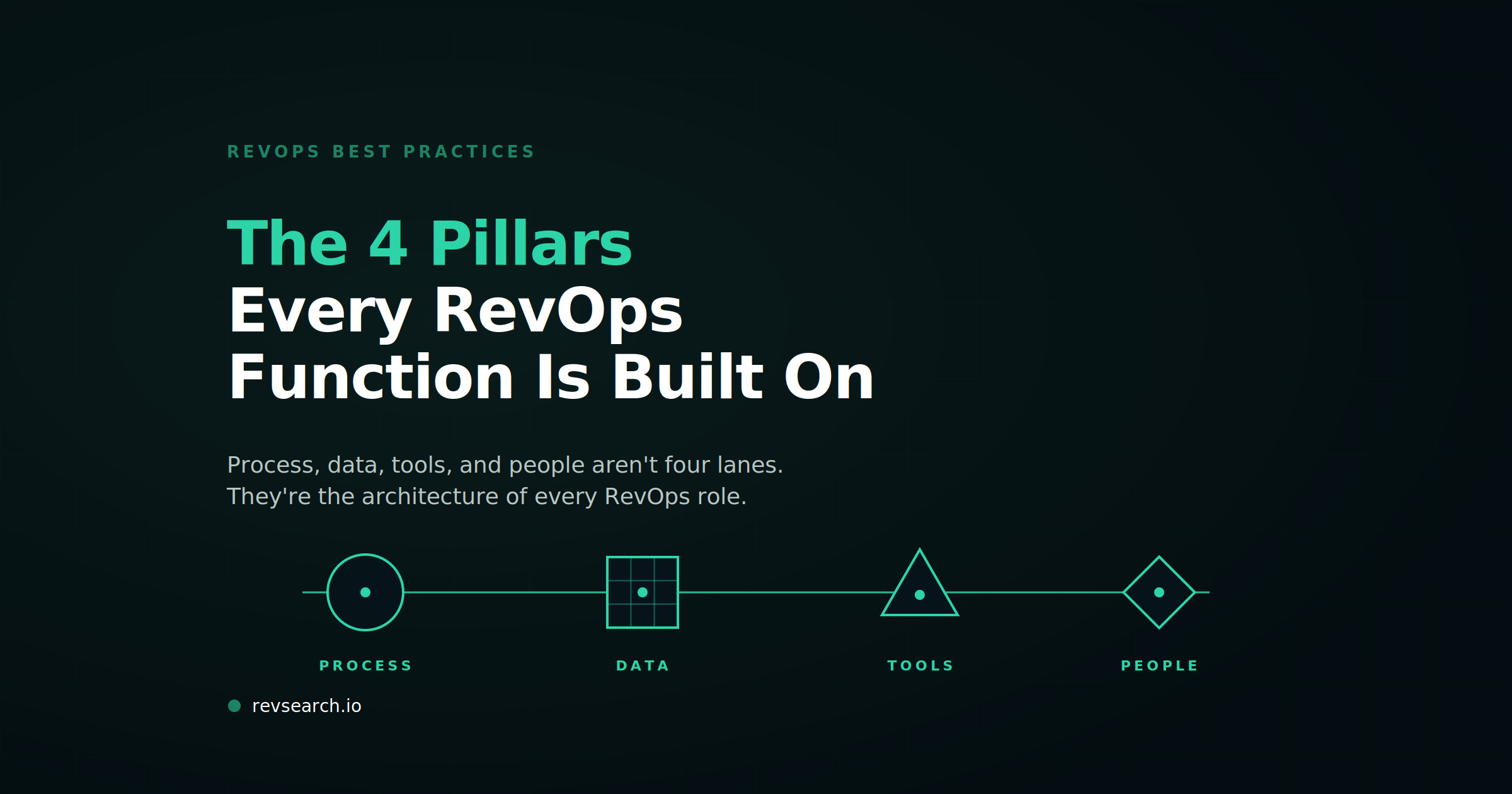
RevOps Best Practices: The 4 Pillars Every RevOps Function Is Built On
Every RevOps leader we place talks about their work in terms of the same four components. Process. Data. Tools. People. Ask any VP of RevOps what their job is on a given Tuesday and you'll get some mix of all four, regardless of whether they run a three-person team at a 30 million ARR portco or a 40-person department at a 1.5 billion ARR portfolio exit candidate.
That consistency is meaningful. Over 50 RevOps placements into PE-backed companies, one pattern has held up across every stage and segment we've worked in. The four pillars aren't four separate disciplines you divide up among specialists. They're the four components that every RevOps role is built on, regardless of specialty or seniority. A Sales Comp Manager works across all four, scoped to comp. A Marketing Ops Manager works across all four, scoped to demand gen. A GTM AI Lead works across all four, scoped to AI adoption. The pillars are the universal job architecture of RevOps work.
The functions that compound value over a PE hold period get that architecture right. The ones that stall almost always get it wrong in the same way, by treating the pillars as lanes instead of components. Here's what the distinction looks like in practice, and what it means for how CROs and CFOs think about building a RevOps function that actually scales.
What the four RevOps pillars actually are
Before we get into hiring, it's worth being specific about what each pillar covers, because a lot of RevOps content treats these terms as if they're self-evident. They aren't.
Process is how revenue work flows. Lead routing and qualification rules. Opportunity stage definitions and exit criteria. Handoffs between marketing, SDR, AE, CS, and finance. Territory and account ownership governance. The documentation and operating cadences that keep the whole thing from turning into tribal knowledge.
Data is what the business can see. Reporting infrastructure and the definitions that sit underneath it. Data hygiene standards. KPI and metric definitions that hold across functions. Attribution logic, pipeline inspection methodology, and the forecasting inputs that the CFO and CRO are actually going to trust on a Monday morning call.
Tools and tech are the systems that enable the work. CRM and MAP at the foundation. CPQ, CLM, BI, conversation intelligence, enrichment, sequencing, and enablement platforms layered on top. And the integrations, data flows, and architecture decisions that determine whether those systems work together or quietly undermine each other.
People are the humans the system is built for and with. Rep enablement and adoption. Change management through leadership transitions and GTM pivots. Cross-functional partnership with finance, marketing, product, and customer success. The behavioral and cultural work that determines whether the other three pillars actually produce value or just produce dashboards nobody opens.
Every RevOps role touches all four. The variation is in scope and emphasis, not in which pillar a person "owns."
Why this matters for how CROs hire
When we evaluate RevOps candidates, at any level, we're not screening for "process people" or "data people." We're assessing fluency across all four pillars, and the balance we need depends on the role and the stage of the function.
The failure mode we see most often is a version of this. A CRO inherits a messy revenue motion 60 days post-close. Salesforce is a wreck. Reports don't reconcile. Forecasting is a guess. The CRO reasonably concludes they need a "systems person" and hires accordingly. Six months later the CRM is cleaner, the reports tie out, and the forecast still isn't any better. The real problem wasn't the tools. It was the process that fed the tools and the adoption behavior that determined whether reps entered data accurately in the first place. A systems hire can't fix that alone because a systems hire doesn't have the process and people fluency the job actually required.
The best RevOps hires, at every level, can move between the pillars in a single afternoon. They can debug a routing rule in the morning, pull the report that proves the rule is working by lunch, and sit with a frustrated AE at 3 PM to figure out why the rep is still routing leads manually anyway. That range is what differentiates a RevOps operator from a functional specialist. It's also harder to screen for than most hiring processes give credit for.
What the four pillars look like in practice
The best way to see why the pillars function as architecture rather than lanes is to look at how they show up simultaneously in actual RevOps work. Here are five examples from across the RevOps ecosystem. Each one is a different scope, a different seniority level, and a different part of the business. All five touch all four pillars at the same time, because that's what RevOps work is.
Marketing Ops. A Marketing Ops Manager negotiating a lead-handoff SLA with sales is working across all four pillars in a single initiative. The handoff itself is process: what qualifies a lead for routing, how fast sales has to respond, what happens when they don't. The SLA only works if it's measurable, which requires data: clean lifecycle stage definitions, attribution logic both teams agree on, reporting that makes the SLA enforceable. The mechanism that moves leads across the handoff and logs the activity is tools: MAP-to-CRM integration, routing rules, scoring models. And the whole thing fails if the people pillar isn't handled, because an SLA that reps and demand gen don't trust is an SLA that gets ignored inside a month.
Customer Success Ops. A CS Ops Manager designing a renewal forecasting motion works across the same four. The renewal cadence, risk escalation paths, and handoff from onboarding to ongoing CSM coverage are all process. The health score methodology, renewal probability inputs, and expansion signal definitions are data. The CS platform configuration, product usage instrumentation, and integration back into the CRM are tools. And whether CSMs actually update health scores honestly, escalate at-risk accounts early, and trust the forecast enough to act on it is people. The renewal number on the board deck is the output of all four working together, not any one of them.
Revenue Intelligence and Signal Ops. A Revenue Intelligence lead at an MM+ company turning conversation intelligence and intent data into pipeline is doing the same thing at a different scope. Deciding which signals matter and how they should trigger rep action is process. Ingesting, normalizing, and scoring the signals across Gong, 6sense, product usage, and enrichment sources is data. The platforms that capture the signals and deliver them into seller workflows are tools. And whether reps actually use the signals, trust them, and change their behavior based on them is people. A Revenue Intelligence function that nails three pillars and misses one produces a very expensive dashboard that changes nothing.
CPQ and Quote-to-Cash Ops. A CPQ and Quote-to-Cash Ops lead configuring pricing for a new product line is working across all four pillars from day one. The approval workflows, discount authority frameworks, and deal desk escalation rules are process. The product catalog logic, pricing model governance, and margin reporting are data. The CPQ platform itself and the ERP handoff are tools. And whether sales reps configure quotes accurately, whether finance trusts the revenue recognition, and whether deal desk gets looped in at the right moment are all people. The strongest CPQ hires we place are the ones who sit at the intersection of finance, sales, and product and can operate credibly with all three.
GTM AI Lead. A GTM AI Lead at a UMM+ company rolling out AI tooling to the sales org is a clean example of why the pillars can't be separated. Deciding which workflows the AI is embedded in and what "good" output looks like is process. The feedback loops, usage metrics, and outcome attribution back to pipeline and revenue are data. The AI platform itself, the integrations, and the governance layer are tools. And driving adoption, managing the behavioral change that comes with generative tooling in seller hands, and connecting AI outputs to revenue outcomes the CRO cares about are all people. Companies make strong AI tooling bets and get zero revenue lift when they treat the rollout as a tools problem. The ones that see the full four-pillar shape get the return.
The pattern across all five examples is the same. RevOps makes an impact on the business through the interaction of process, data, tools, and people applied to a specific part of the revenue motion. Pull any one pillar out of any one of these initiatives and the work stops producing value. That's what it means for the pillars to be the architecture of RevOps work rather than four separate disciplines.
How the pillar emphasis shifts by role and stage
At the first RevOps hire, the work across all four pillars is roughly evenly distributed, with a slight tilt toward process and people. There's no system to maintain yet. The hire is building one that the go-to-market team will actually use, which means the design work has to account for adoption from day one.
This is why first RevOps hires should lean generalist. Specialists get hired into functions that already work. A specialist hired as a first RevOps hire typically defaults to the kind of work they've done before, which leaves large gaps in the other areas the foundational build-out requires. That pattern is holding in the AI era, not breaking. Cedric Savarese, writing in VentureBeat, makes the case that AI is actually raising the value of capable generalists, because the people who can move fluidly across functions and evaluate AI-produced work against a broader context are the ones who turn AI output into something the business can rely on. That describes the RevOps generalist profile almost exactly.
As the function scales and specialists come on, the scope of each role narrows but the four-pillar architecture doesn't. A Pricing Ops Manager is still working across process, data, tools, and people, just scoped to pricing. An SDR/BDR Ops Manager running cadence governance and AI-assisted prospecting workflows is working across all four scoped to top-of-funnel seller behavior. A Partner and Channel Ops lead, a role nearly absent from most current RevOps frameworks but increasingly important at MM+, is working across all four scoped to the partner motion. What shifts with specialization is how much of each pillar's surface area the role is responsible for, not which pillars the role touches.
The VP or SVP of RevOps role sits across all four pillars at the function level, integrating the specialist work happening beneath it. That integration is the job. The RevOps leader is the person making sure the specialist work in data doesn't drift out of alignment with the specialist work in process, and that neither of them loses sight of the people pillar that determines whether any of it lands.
The question we ask when evaluating any RevOps candidate isn't "which pillar do they own?" It's "across the scope of this role, how fluently do they operate across all four pillars, and does that fluency match what this specific role, at this specific stage, actually needs?" Those are different questions, and the hiring processes that only ask the first one tend to produce the kind of lopsided RevOps functions that stall.
The pattern we see in RevOps functions that scale
The RevOps functions we see compound value over a PE hold period share one structural trait. They're built by people who read across all four pillars fluently, and they hire with the pillar architecture in mind from the first hire forward.
The ones that stall are almost always built as four specialist lanes bolted together. The tools person can't fix a process problem. The data person can't drive adoption. The process person can't evaluate a tooling investment. The comp person ends up owning change management by default because nobody else will. The function becomes four people doing four jobs instead of one function doing the whole job, and the CRO ends up being the integration layer between them, which is not a scalable use of CRO time.
The four pillars are the grammar of RevOps work. Every role speaks it. The question for any RevOps hire, from a first-hire generalist to a specialist in a 50-person department, is how fluently they speak it and whether their accent matches the role you're hiring for.
For more on why PE firms are treating the RevOps build-out as a portfolio-wide priority rather than a portco-by-portco decision, see Why PE Firms Are Making RevOps a Portfolio-Wide Priority.
Frequently Asked Questions
-
The four pillars of RevOps are process, data, tools, and people. Process covers how revenue work flows across marketing, sales, and customer success. Data covers reporting, KPI definitions, and the forecasting inputs leadership relies on. Tools covers the CRM, MAP, CPQ, BI, and conversation intelligence stack that enables the work. People covers enablement, adoption, change management, and cross-functional partnership. The pillars aren't four separate disciplines. They're the four components every RevOps role is built on, regardless of specialty.
-
Every specialized RevOps role works across all four pillars, scoped to that function's focus area. A Marketing Ops Manager works across process (lead handoffs, SLA governance), data (attribution, lifecycle reporting), tools (MAP, integrations), and people (demand gen partnership, adoption). A Customer Success Ops Manager works across the same four, scoped to renewal cadences, health scoring, CS platforms, and CSM behavior. The dominant pillar varies by role, but no RevOps specialty is single-pillar.
-
A first RevOps hire should lean generalist. The role at that stage requires fluency across all four pillars because the function is being built, not maintained. Specialists hired as first RevOps hires tend to over-invest in their strongest pillar and under-invest in the other three, which leaves the function lopsided. Specialists add the most value when they join a function that already has foundational process, data, tools, and people work in place, and they're brought in to go deeper in a specific area.
-
Specialized RevOps roles typically come online at the upper mid-market and above, once the foundational function is stable and the company has scale that justifies the investment. GTM AI Lead roles are being actively created at UMM and larger companies right now. Revenue Intelligence and Signal Ops roles are showing up at MM and larger. Partner and Channel Ops, Pricing Ops, and Sales Capacity Planning usually arrive in the same window. The common thread is that these roles emerge when the core function has enough maturity that a specialist can produce value without having to fix broken foundations first.