Why PE Firms Are Making RevOps a Portfolio-Wide Priority
The value creation playbook in private equity has fundamentally changed and revenue operations is at the center of what comes next.
Private equity entered 2026 under a different set of pressures than any cycle before it. Holding periods have stretched to 6.7 years (the longest since 2005). Interest rates remain elevated. AI is reshaping how portfolio companies operate, what roles they need, and how fast the best firms expect to see returns. And LPs are no longer accepting financial engineering as the primary driver of fund performance.
The numbers tell the story: since 2010, according to PwC’s PE Operating Partner Trend Report, operational improvements have driven 47% of value creation in PE buyouts, while financial engineering has dropped to 25%, down from 51% in the 1980s. And that trend is accelerating.
That's not a subtle shift. It's a structural inversion.
And it has a direct implication for where Operating Partners invest post-close. When the thesis lives inside portfolio company operations and when returns depend on revenue predictability, pipeline discipline, and GTM efficiency, then the people building that operational infrastructure become thesis-critical hires.
The function responsible for that infrastructure has a name: Revenue Operations.
At RevSearch, we've placed RevOps leaders into PE-backed companies at every stage, from the first hire 60 days after close to fully scaled teams running GTM analytics, sales compensation, deal desk, and marketing ops. What we're seeing across those placements is a clear pattern: the firms treating RevOps as a portfolio-wide capability, not a one-off hire at individual portcos, are compressing their value creation timelines and exiting stronger.
This piece lays out why that shift is happening, what the best firms are doing differently, and what it takes to build RevOps as a value creation lever across a portfolio.
The Economics Have Changed. The Playbook Has to Follow.
Private equity entered 2026 as a mature industry. The tailwinds that amplified returns for a generation and declining interest rates, expanding multiples, abundant leverage are all gone.
The data from recent PE conferences reinforces how definitively this shift has landed. At PEI NEXUS Orlando, a panel featuring leaders from Brookfield, GTCR, and other top firms made the point directly: 50% of Brookfield's returns now come from operating improvements, not multiple expansion. GTCR is running 4-5x leverage (well below industry averages) betting on growth over financial engineering.
The message was consistent: margin expansion, pricing optimization, and organic growth are where returns come from now.
For Operating Partners, this changes the calculus on where to invest post-close. Cost reduction still matters, but it's table stakes. The firms pulling ahead are the ones building repeatable infrastructure for revenue growth and that requires a function most portfolio companies either don't have or have underbuilt.
Why Revenue Operations, and Why Now
PE-backed companies, especially in SaaS, tech-enabled services, and recurring revenue models, run complex go-to-market motions across sales, marketing, and customer success. Without a unifying operational layer, those functions produce fragmented data, misaligned forecasts, and conflicting KPIs. The CRO sees one pipeline number. The CFO sees another. The board gets a third. Nobody trusts the forecast. Nobody can tell you why win rates dropped last quarter or which segments are actually driving net-new ARR.
RevOps is the connective tissue that solves this. It owns the systems, processes, data governance, and cross-functional workflows that make the revenue engine run as a single, instrumented system rather than three siloed departments sharing a CRM.
Matt Gallagher, Portfolio CRO at Hg, frames the function in clinical terms: RevOps is "the doctor's chart". It provides all the readings needed to diagnose properly and make decisions with precision in compressed timeframes. And in private equity, where you have roughly 20 quarters to triple a company's value, proper diagnosis isn't optional.
““The most important thing when you have a growth issue is proper diagnosis. You’ve got to be able to find out where the problem is. Because if you go in and you try to solve the wrong problem, you’ve lost all that time. You have 20 quarters to get this right. You just can’t lose that many.””
But, RevOps isn't new. Its role in PE-backed companies has simply changed dramatically driven by three converging forces.
The economics demand operational growth. With elevated borrowing costs and compressed multiples, firms can't lever their way to returns. They need organic revenue growth. And organic revenue growth at PE speed requires operational infrastructure that most portfolio companies don't have. McKinsey's 2026 Global Private Markets Report put it directly: the conditions that once amplified returns have passed, and outcomes will increasingly be shaped by deliberate operational choices.
AI is accelerating the timeline. AI is reshaping the RevOps function itself - from forecasting to pipeline analysis to lead scoring - but it's also raising the bar for what boards expect. Operating Partners who saw AI generate board-ready reports in minutes are now asking why their portcos still spend two weeks building quarterly decks manually. The gap between what's possible and what most portfolio companies actually deliver has widened, and RevOps is the function responsible for closing it.
The talent market has professionalized. Five years ago, "RevOps" at a portfolio company usually meant a Salesforce admin who also ran reports. Today, 79% of organizations have a formal RevOps function. Gartner projects that by 2026, 75% of the highest-growth companies will operate with a RevOps model. LinkedIn data shows the Director of RevOps is the fourth fastest-growing role in America. The function has grown from roughly 5,800 professionals in early 2022 to over 150,000. This is professionalization, not merely hype.
For Operating Partners, the implication is clear: if your value creation thesis depends on organic revenue growth (and in 2026, it almost certainly does) then RevOps isn't a nice-to-have. It's thesis-critical. As critical to the growth plan as a strong CFO is to the financial plan.
What Many Firms Get Wrong About RevOps Talent (and What Our Client Got Right)
Here's the pattern we see over and over across hundreds of RevOps placements: most PE-backed companies wait too long to hire for RevOps, and when they do, they hire for the wrong profile.
The typical path looks like this. A portfolio company closes. The first 100 days are consumed by financial integration, leadership assessment, and the initial operating plan. RevOps doesn't make the Day 1 list. Six months later, the CRO is frustrated because pipeline data is unreliable. The CFO can't reconcile revenue forecasts with bookings. The sales team is spending 30% of their time on manual processes instead of selling. Someone says, "We need a Salesforce admin."
That's the wrong hire.
What they actually need is someone who can architect the entire revenue operating model: pipeline governance, stage definitions, forecast methodology, data governance, cross-functional process design, and a roadmap for the tech stack. A CRM admin maintains a system. A RevOps leader designs the system that the business runs on.
Our work with a recent client illustrates what getting this right looks like. The company, a category-leading construction tech and IIoT platform with $150M+ in revenue, had scaled rapidly into a global business spanning EMEA, the Americas, and APJ. Like every high-growth company entering its next chapter, they recognized that the GTM infrastructure that had carried them through hypergrowth needed to evolve to support the scale of what was coming next: a major PE ownership transition with Goldman Sachs and Hg.
Rather than waiting until after the transaction to address it, their leadership made a forward-looking call. They partnered with RevSearch to bring in a competent VP of RevOps ahead of the curve, not behind it.
Over the next 18 months, the RevOps VP worked alongside leadership to build a world-class RevOps function: a unified customer framework, harmonized sales processes across three global regions, and forecasting infrastructure that gave leadership richer forward visibility into the business. The outcome was trusted data, predictable pipeline, and board-ready reporting that helped underpin an over $1B transaction.
“As you start adding layers of people and new business across different regions, the operating model has to evolve with you. Now we (the RevOps team) are the main intersection helping with data, process, and planning. The leadership has clear forward visibility into where the business is heading, not just where it’s been.”
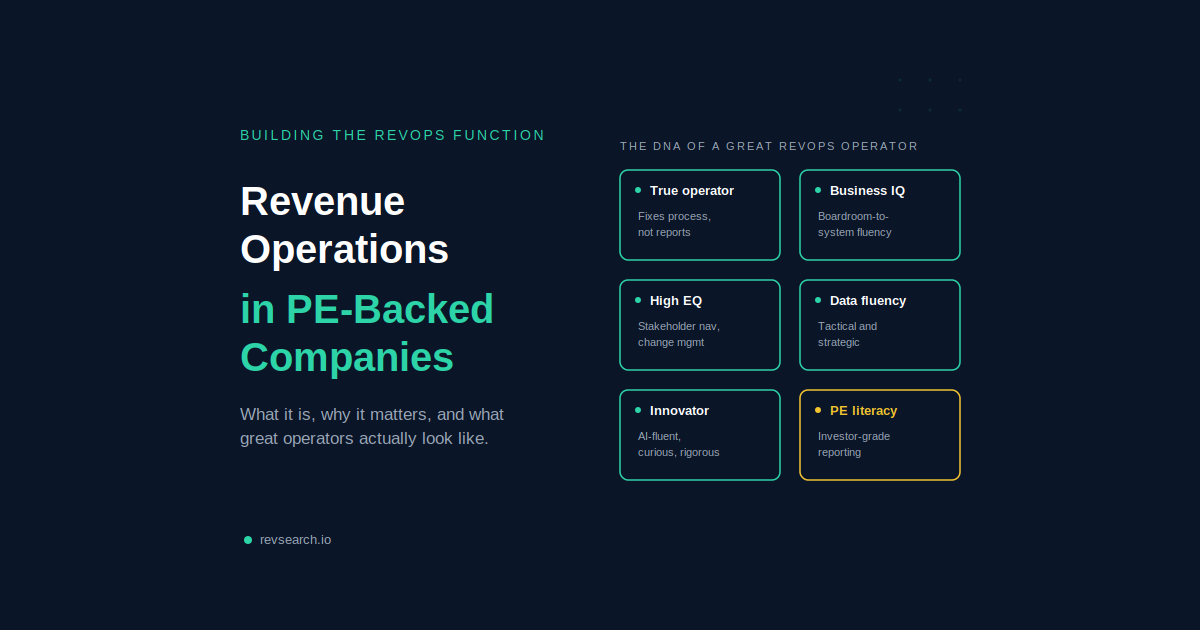
The distinction matters for talent strategy. When evaluating RevOps candidates, the first question isn't technical, but architectural and strategic. It comes down to Business IQ and EQ. Can this person design the operating model? Can they get cross-functional buy-in from sales, marketing, and CS leadership simultaneously? Can they sequence change so the quick, non-emotional wins come first, building credibility before touching anything tied to someone's paycheck?
That last point is critical and often overlooked. RevOps leaders are asked to professionalize sales comp plans, roll out new CRM capabilities to teams that didn't ask for them, and change pricing structures that directly affect how reps get paid. Every one of those initiatives is highly emotional. The best RevOps leaders we've encountered lead with education, not mandates. They build relationships at the leadership level first, cascade messaging through managers, and sequence initiatives by emotional impact, starting with the operational wins that establish trust.
That's change leadership. And it requires a level of EQ that separates a good operator from a transformational one.
This is also why Gallagher at Hg views RevOps as a systematic investment across the firm's entire portfolio, not just a fix for struggling companies. When he tried tapping his network for a RevOps hire at NContracts, one of Hg's portfolio companies, two contacts gave him the same answer: "If I had somebody like that, I wouldn't let you have them." The scarcity of RevOps talent who combine diagnostic capability with PE fluency is real and it's why building a talent pipeline proactively, before you need it, has become a competitive advantage at the fund level.
The Portfolio-Wide Playbook: How Top Firms Are Standardizing RevOps
The firms generating the most consistent returns from RevOps aren't treating it as a portco-by-portco exercise. They're building portfolio-wide capabilities.
We see this play out across three levels of maturity:
Portco-by-portco (reactive). Each company figures out RevOps on its own. No standard hiring profiles, no shared tech stack recommendations, no benchmarks across the portfolio. The Operating Partner might flag RevOps as a priority, but execution is left entirely to portco leadership. This is where most firms still are and it's the most expensive approach. Every portco makes the same mistakes independently: they hire too junior, buy the wrong tools, and spend six months rebuilding what another portco in the same portfolio already solved.
Shared frameworks (proactive). The PE firm develops a RevOps playbook with recommended tech stack, hiring profile templates, KPI frameworks, org design guidance and deploys it to portcos as part of the post-acquisition operating plan. The Operating Partner or portfolio operations team socializes the playbook, but each portco executes independently with its own hires. This is a significant step up. It compresses time-to-value and reduces costly missteps, especially on hiring.
Centralized capability (strategic). The firm has a repeatable RevOps deployment model. Standard hiring profiles are pre-defined by company stage and complexity. Onboarding playbooks exist for the first 30/60/90 days. KPI frameworks are consistent enough across portcos that the firm can benchmark portfolio-wide. And critically, the firm has a pre-vetted talent pipeline of relationships with proven RevOps leaders who can be deployed within weeks of close rather than months.
The firms at Level 3 are rare, but they have a structural advantage. When a new acquisition closes, they aren't starting from scratch on RevOps talent. They already know the profile that works, they have a bench to pull from, and they can get a RevOps leader onboarded before the competitive window closes.
Hg's approach illustrates this trajectory. With 58 portfolio companies, Gallagher isn't evaluating RevOps as a one-off investment but is building diagnostic capability as a repeatable portfolio-wide lever. Each successful placement generates pattern recognition that informs the next: what profiles ramp fastest, which capabilities matter most by company stage, and how to structure the function so CROs can shift from data interpretation to strategic planning.
This is why the most forward-thinking Operating Partners are building RevOps into their pre-close diligence, not just their post-close operating plan. Assessing a target's GTM infrastructure during diligence with questions like “how reliable is the pipeline data? Is there a single source of truth? Who owns the operating model?” changes both the confidence of the bid and the speed of post-close execution.
The RevOps Ecosystem: What to Build and When
"What should my RevOps team look like, and when should I build it?"
The answer depends on stage and complexity. But across hundreds of RevOps placements into PE-backed companies, we've mapped the full GTM operations ecosystem, the roles, the sequence, and critically, how the leadership profile evolves as the function scales. We think about it in three stages, defined not by headcount or timeline but by what the company needs from the operator running it.
Getting this progression right is one of the highest-leverage decisions an Operating Partner or CRO can make. Hire specialists before you have a strategist, or bring on a strategist and never give them a team, and you'll burn through 12-18 months before the function delivers real value.
Stage 1 - The Strategic IC: Systems Builder (LMM / $10M–$50M revenue)
This is typically a 1-2 person operation often with a Director-level hire operating as a strategic individual contributor. No direct reports yet, but the role carries Director-level scope, stakeholder access, and decision-making authority. This person owns everything: GTM strategy and planning, the revenue tech stack, basic analytics, enablement, and sales compensation design in partnership with Finance. The foundation they build of data architecture, CRM hygiene, process design, metric definitions, PE-grade reporting is the 80% that makes everything else work. Marketing ops and customer success typically sit outside RevOps here, running independently until the function matures enough to bring them into alignment.
The critical mistake at this stage: hiring an analyst or CRM admin when you need a strategist.
Stage 2 - The Team Builder: Emerging Leader (MM / $50M–$500M revenue)
The RevOps leader now has 3-8+ people and the role evolves from Director to VP and is someone who still gets hands dirty but can coach, delegate, and influence cross-functionally. Each core pillar gets dedicated ownership: a systems team managing the tech stack, a dedicated analytics function moving from descriptive to predictive, and an enablement lead building the training infrastructure that transforms individual talent into repeatable growth. Specialized functions start splitting off as sales compensation and territory planning becomes its own workstream, GTM-facing FP&A becomes a critical bridge between the CRO and CFO, and marketing ops and customer success ops begin dotted-line aligning with RevOps through shared data models and unified dashboards. AI gets operationalized at this stage, embedded into pillar workflows with experienced operators paired alongside AI-native talent.
Stage 3 — The Executive Operator: VP / Sr. Director (UMM / $500M-$1B revenue)
At scale, the function spans 20-50+ people across Director-led pillars, with the VP or Sr. Director operating as a true executive voice at the leadership table owning M&A integration, org design, and board communication. Marketing ops and customer success ops are fully integrated under RevOps. GTM analytics becomes the nerve center. Sales compensation operates across segments, geographies, and overlay models. AI is embedded across every pillar. The best operators at this stage know they're building the infrastructure and the team that Stage 4 will run on.
Stage 4 - The GTM operations executive: VP / SVP (Large Cap/Public / $1B+)
At this scale, RevOps is no longer a function but a department. 50-100+ people across multiple VPs or Sr. Directors, each owning a regional or functional vertical. The leader carries a VP or SVP title with direct board access and sits on the executive leadership team. They own the GTM operating model across business units, geographies, and go-to-market motions that may include direct sales, channel, PLG, and marketplace simultaneously. M&A integration is a standing workstream, not a one-time project. The RevOps executive is architecting the company's GTM AI operating system at enterprise scale with AI agents handling operational tasks across every pillar, adaptive forecasting that updates in real time, and predictive deal intelligence that informs capital allocation. But the core job hasn't changed from Stage 1: make revenue predictable, visible, and scalable.
The through-line across all three stages
The operator DNA is constant: high IQ/EQ, data fluency, systems thinking, business impact orientation. What changes is the scope, the team, and the level of organizational influence. The best operators build the foundation first - data, process, tech stack, governance, stakeholder trust - then layer AI on top to multiply impact. AI amplifies the operator. It doesn't replace the operating model.
And each function within this ecosystem is too niche to recruit for in isolation. Bundled together, they form the GTM operations practice and knowing what profile succeeds at each stage is what separates firms that build RevOps well from those that keep rebuilding it.
The EBITDA Case for RevOps Investment
Operating Partners and boards think in EBITDA, not in Salesforce dashboards. Here's how RevOps directly impacts the metrics that drive valuations:
Forecast accuracy. Reliable forecasting is the single most common gap we hear about from CROs in PE-backed companies. When the forecast is wrong, resource allocation is wrong. Hiring plans are wrong. Board conversations erode trust. A strong RevOps function builds the pipeline governance, stage validation, and data discipline that makes the forecast trustworthy. That shifts board conversations from "is this number real?" to "here's how we accelerate it."
Pipeline velocity. RevOps identifies where deals stall, which conversion rates are underperforming by segment, and where process changes can compress cycle times. These are the difference between a 90-day and a 120-day average sales cycle, which at scale represents millions in revenue acceleration.
CAC efficiency. When marketing and sales operate on separate data, separate definitions, and separate tools, acquisition costs balloon. RevOps unifies the data layer and creates shared accountability for funnel metrics. Leading teams now track CAC by channel, segment, and customer cohort in near-real time, optimizing spend dynamically rather than waiting for annual budget resets.
Net revenue retention. NRR is increasingly a board-level metric for SaaS companies. RevOps plays a direct role by aligning post-sales teams with the same data infrastructure and process discipline that governs new business.RevOps is the function that ensures renewal forecasts, expansion pipelines, and customer health scores are tracked and acted on consistently.
Revenue per headcount. In an environment where capital efficiency matters more than headcount growth, RevOps drives productivity. Automating manual processes, reducing CRM friction, and giving reps better data means more revenue from the same team. That's direct margin improvement.
None of this is theoretical. Research consistently shows that companies with mature RevOps functions grow revenue significantly faster than peers, and companies without RevOps lose substantial potential revenue to operational inefficiencies. For a PE firm holding a portfolio company for 5-7 years, the cumulative impact on EBITDA, and therefore on exit multiple, is material.
The Talent Bottleneck Is Real
The strategic case for RevOps is settled. The execution challenge is talent.
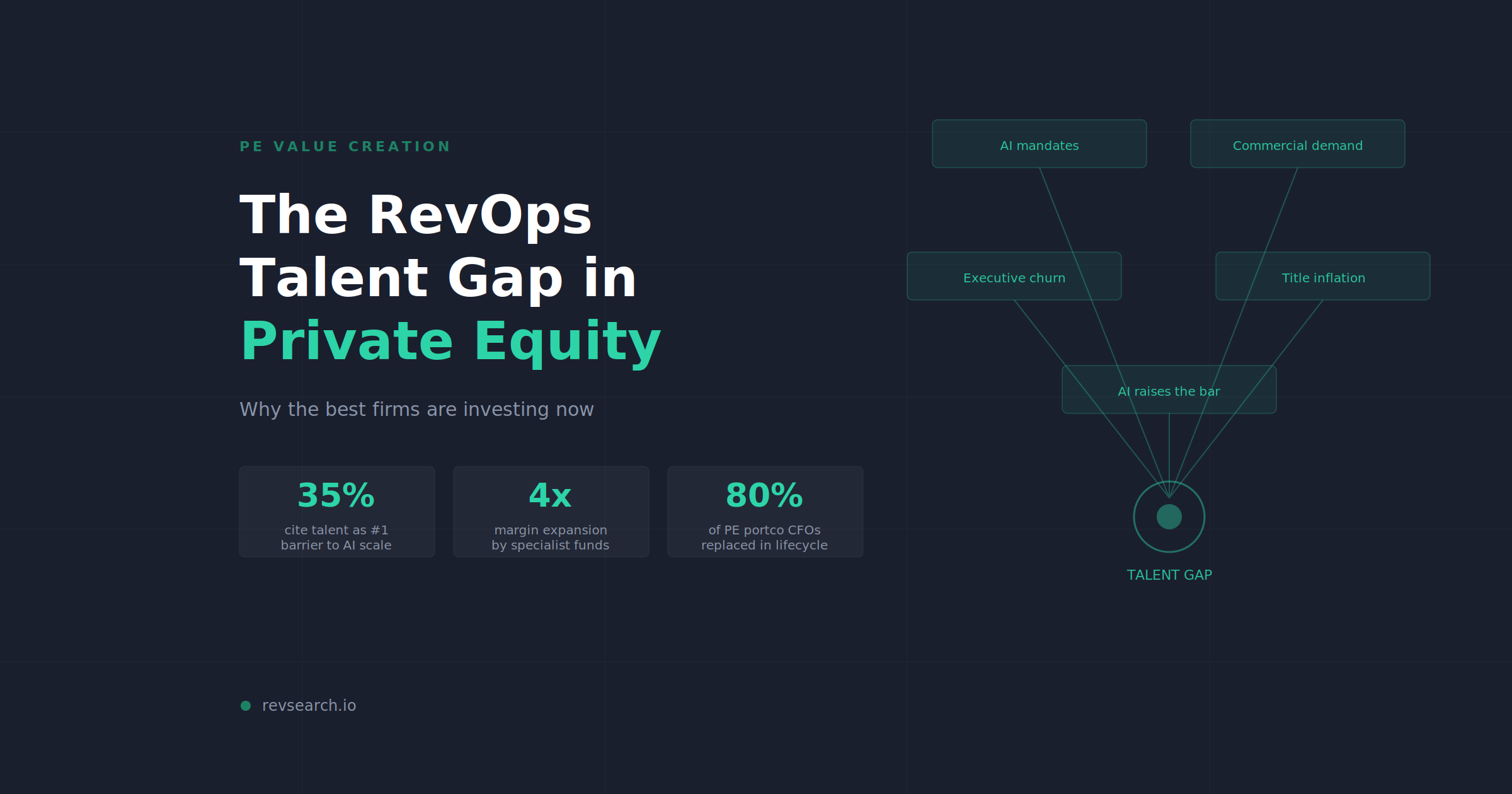
RevOps has exploded as a function, but the supply of senior RevOps leaders who understand PE environments of board dynamics, compressed timelines, and value creation pressure still lags demand significantly. A VP of RevOps who has successfully built the function at a PE-backed SaaS company through a full hold period and exit is a rare profile. A VP of RevOps who has done it across different stages, industries, and go-to-market models is even rarer.
This is where talent strategy becomes a competitive advantage at the fund level. The firms that build relationships with proven RevOps talent before they need to deploy it have a structural edge.
RevSearch exists in this gap. We've placed RevOps leaders into PE-backed companies across tech-enabled services, SaaS, and hardware+software companies from first hire through fully scaled teams. We see the full talent landscape: who's available, who's proven, what profiles succeed at which stages, and what the market is paying for them. That pattern recognition, built across 5 years of placements, is what lets us move fast when a firm needs the right RevOps leader in the chair within weeks, not months.
If your firm is building RevOps into the value creation plan or thinking about making it a portfolio-wide priority, we should talk.
Frequently Asked Questions
-
Revenue operations is the function that unifies systems, processes, data, and workflows across sales, marketing, and customer success. In PE-backed companies, RevOps serves as the operational infrastructure that makes revenue predictable, visible to the board, and scalable, directly supporting the value creation thesis.
-
The strongest outcomes come from hiring a Director or VP-level RevOps leader within the first 100 days post-close. This allows the RevOps leader to design the revenue operating model before process debt accumulates and before critical go-to-market decisions are made without data. Waiting six months typically means spending the next six months fixing avoidable problems.
-
Sales Operations focuses on sales-specific processes and execution tools. Revenue Operations spans the full customer lifecycle (from first marketing touch through renewal and expansion) integrating people, processes, and technology across all revenue-generating functions. PE-backed companies with complex GTM motions increasingly need both, with Sales Ops operating within the broader framework RevOps sets.
-
RevOps drives EBITDA through multiple levers: improved forecast accuracy reduces resource misallocation, pipeline velocity improvements accelerate revenue, unified data reduces customer acquisition costs, and process automation increases revenue per headcount. It also frees CRO capacity for strategic work rather than data interpretation, a leverage point that compounds over a full hold period.
-
The most effective approach progresses through three levels: providing shared frameworks and hiring profiles to portcos, deploying consistent KPI benchmarks across the portfolio, and ultimately building a pre-vetted talent pipeline that allows rapid deployment of proven RevOps leaders into new acquisitions. RevSearch partners with PE firms at all three levels.