
The RevOps Talent Gap in Private Equity: Why the Best Firms Are Investing Now
Private equity has entered its operational era. The levers that defined the last two decades (cheap leverage, multiple expansion, financial engineering) are largely spent. What's left is the harder, slower work: building portfolio companies that generate real EBITDA growth, quarter after quarter, through operational excellence.
That shift is well documented. What gets discussed less often is the downstream consequence. The people who actually execute operational value creation inside portfolio companies are now among the scarcest resources in the market. One of those roles, sitting at the intersection of revenue, data, process, and cross-functional adoption, is Revenue Operations.
The firms moving fastest on this aren't treating RevOps as a reactive hire when a portco CRO escalates. They're treating it as a portfolio-wide talent thesis.
Operational Excellence Is the New Alpha
The macro picture is clear. McKinsey's 2026 Global Private Equity Report found that across 2010 to 2022 vintages, specialist buyout funds generated nearly four times as much equity value from EBITDA margin expansion as generalists, at 43% versus 10%. Specialist funds also produced higher pooled IRRs (17% vs. 13%) and lower loss ratios. The common thread running through these outperformers is deeper operational capability.
The returns math has also shifted underneath the industry. Borrowing costs are higher, multiples are compressed, and the value creation burden has moved from the capital structure to the operating model. Returns increasingly depend on operators inside portfolio companies who can generate sustained EBITDA growth through pricing discipline, commercial execution, and operational efficiency.
That raises a practical question. Who, specifically, inside a portfolio company is equipped to do that work?
The Operator You Can't Afford to Hire Late
A lot of people contribute to operational value creation inside a portco. CFOs own the financial architecture. CROs own commercial strategy. Operating partners set direction from the fund level. RevOps doesn't replace any of that.
What a strong RevOps leader does is own the end-to-end revenue process. They evaluate the full customer lifecycle, from lead generation through expansion and renewal, and architect the systems, data flows, and processes that make the entire cycle measurable and repeatable. They look at the business holistically and identify where the revenue engine is leaking value, where forecasting breaks down, where handoffs between teams create blind spots, and where operational improvements will have the highest impact on growth and margin.
That's strategic work. It's also the work that makes every other leader in the building more effective. The CRO gets pipeline visibility they can actually trust. The CFO gets revenue data that holds up in a board presentation. The operating partner gets a single source of truth across the portco without having to stitch it together themselves.
The mistake most portfolio companies make isn't hiring the wrong person. It's hiring too late. RevOps foundations set in the first 100 days post-close become the operating system for the entire hold period. When that hire doesn't happen until month nine or twelve, the company has already built reporting workarounds, accumulated process debt, and made critical go-to-market decisions without the data infrastructure to support them. That's not a setback you recover from quickly. That's a structural delay to the value creation plan.
Forces Compounding the RevOps Talent Gap
The shortage of qualified RevOps leaders for PE-backed companies isn't a single problem. It's several forces converging at once, each making the others worse.
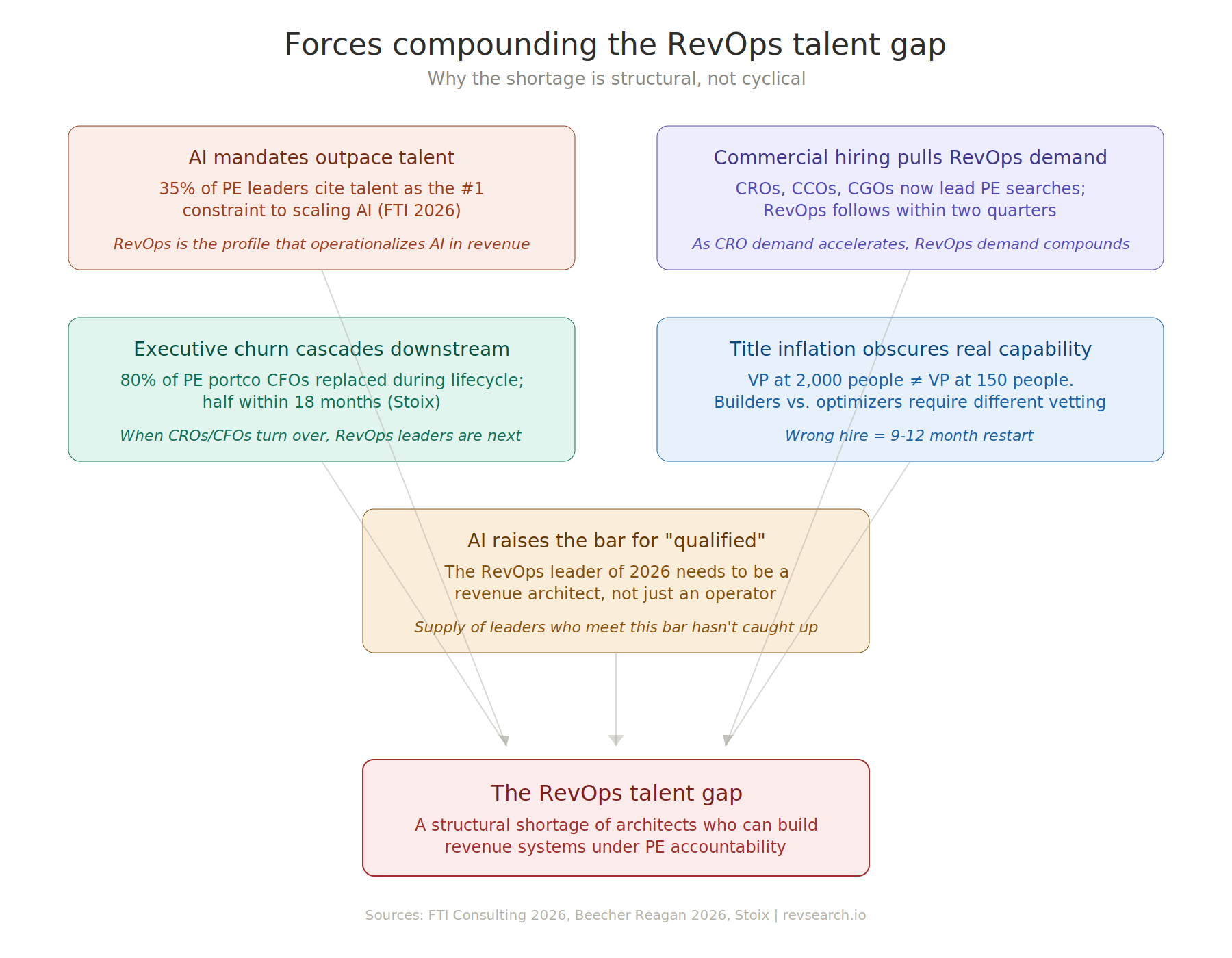
AI mandates are outpacing the talent to execute them. AI has become the fastest-growing initiative inside portfolio companies. FTI Consulting's 2026 Private Equity AI Radar surveyed PE fund leaders and operating partners and found that revenue acceleration is now the number one AI priority across portfolios, cited by 41% of respondents. But the same survey surfaced a constraint that most firms are still working through. Talent is the number one barrier to scaling AI adoption, cited by 35% of respondents. The operator who lives at the intersection of data, process, tools, and people and can translate an AI playbook into operational reality is a RevOps profile. And there aren't enough of them.
Commercial leadership demand is pulling RevOps demand with it. Beecher Reagan's 2026 Executive Talent Trends Report found that CROs, CCOs, and CGOs are moving to the front of the hiring line in PE, replacing the CFO-heavy searches that dominated recent years. When a commercial executive lands at a PE-backed portco, the RevOps hire usually follows within two quarters. The two roles are increasingly inseparable. As CRO and CCO demand accelerates, RevOps demand compounds with it, and the supply side hasn't caught up.
Executive churn cascades downstream. Research from Stoix found that 80% of portfolio company CFOs are replaced during the PE lifecycle, with half gone within 18 months. The same pattern holds for CROs. When a senior revenue or finance executive turns over, the RevOps leader almost always turns over next. Not because they failed, but because the new executive needs someone scoped for a different operating model. The market is absorbing constant top-of-house disruption, and the downstream RevOps churn follows it.
Title inflation obscures real capability. The RevOps market has exploded over the last five years, and with it, title inflation. A "VP of RevOps" at a 2,000-person company often means something entirely different than a VP of RevOps at a 150-person portco. The former has optimized a mature system with established playbooks and large teams. The latter needs to build from scratch, often as the first or second RevOps hire, with limited resources and a board that expects results within quarters. When PE-backed companies hire based on title rather than what someone has actually built, ramp time stretches and the risk of a restart goes up significantly.
AI has raised the bar for what “qualified” means. This is the force most firms haven't fully priced in yet. AI is an accelerant, not a replacement for human judgment. It can automate a forecasting overlay, build a model, and clean up billing reconciliation. It can't tell you why your pipeline is broken, diagnose the incentive structure quietly destroying your margins, or sit in front of a PE partner and defend the number. That takes an architect. The RevOps leaders succeeding in AI-enabled portfolios are the ones who can design a revenue system that humans and agents can execute against. They structure the data foundation, define the business logic, and own the decision of where AI amplifies value versus where it introduces risk. Architecture first. Acceleration second. AI doesn't reduce the need for RevOps. It raises the bar for what a RevOps leader has to be, and the supply of leaders who meet that bar hasn't caught up.
What We're Seeing From Firms Solving for This
This talent gap is a current reality, and the response to it is still taking shape across the industry. That said, in the RevOps searches we're running for PE-backed companies right now, a few patterns are emerging among the firms that are getting ahead of it.
Some are starting to treat RevOps as a portfolio-wide talent priority. Operating partners at these firms are standardizing what "great" looks like at each stage of portco maturity, whether that's the first RevOps hire at $15M ARR, a specialized team at $75M ARR, or a fully scaled ecosystem by $150M+. Having consistent profile criteria across the portfolio allows them to move faster when a need surfaces, instead of rebuilding the search criteria from scratch every time.
Others are scoping the role differently from the start. They're hiring for someone who can architect a revenue system under PE accountability, not just manage tools. That distinction changes the candidate pool, the interview process, and the evaluation criteria.
The firms we see making the most progress are also evaluating for the full stack. Technical competency is the floor. What separates transformational RevOps leaders from tactical ones is EQ: the ability to drive change across functions without authority, communicate to the board in value creation language, and earn trust with a CFO who's skeptical of anything that sounds like sales ops. These traits are the hardest to screen for and the most reliable predictors of success in the seat.
And increasingly, we're seeing firms evaluate for AI architectural capability alongside operational depth. That's a new filter, and it's changing which candidates rise to the top of a search.
The Solution Is a Pipeline, Not a Panic Search
The single biggest operational shift we're seeing among effective PE firms is a refusal to start RevOps searches from scratch every time a portco needs one.
A reactive search, the kind that kicks off when a portco CRO sends a frustrated Slack message six months post-close, almost always takes too long. By the time a firm runs an internal referral process, gets a search firm briefed, sources a slate, works through interviews, makes an offer, and onboards the hire, two to three quarters have passed. In a 20-quarter hold period, that's a meaningful portion of the value creation window spent without the right operator in the seat.
The firms closing the talent gap fastest are building a pipeline of pre-vetted RevOps talent at the portfolio level before specific needs arise. They have relationships with proven RevOps operators across every stage of portco maturity. They know who has built from zero at a $30M SaaS company, who has scaled through a $75M inflection point, and who has led a team of ten through an exit. When a portco needs a RevOps leader, the firm isn't starting a search. They're activating a relationship.
This is where a specialized recruiting partner changes the math. A firm that only places RevOps leaders into PE-backed environments is having ongoing conversations with this talent pool, independent of whether any specific search is active. The pattern recognition built across those conversations, across years of evaluating which profiles succeed at which stages, is what allows pipeline-based placement to actually work. Without that depth, "pipeline" becomes a list of names in a CRM, not a genuine bench.
The distinction matters when the timeline matters. And in PE, the timeline always matters.
The Opportunity Cost of Waiting
Every quarter a portfolio company operates without a capable RevOps leader is a quarter where board presentations rely on gut feel, pipeline reviews miss the real problems, and the CRO spends time building decks instead of building strategy.
Compound that across a portfolio of 20 companies, and the cost isn't incremental. It's structural.
The firms building RevOps talent strategy at the portfolio level, with pre-vetted pipelines ready to deploy into newly acquired portcos, will have a measurable edge in the operational era. The firms still treating it as a one-off hire when problems surface will keep losing quarters they can't recover.
The RevOps talent gap is real. It's closing fastest for the firms that have stopped seeing it as a staffing problem and started seeing it as a portfolio strategy problem.
If your firm is building RevOps into the portfolio value creation plan, we should talk. We've spent years placing RevOps leaders into PE-backed companies across tech-enabled services, SaaS, and hardware+software, from first hire through fully scaled teams. The pattern recognition we've built across those searches is what lets us move fast when a firm needs the right profile in the chair within weeks, not months. Let's connect.
Frequently Asked Questions
-
The RevOps talent gap refers to the structural shortage of qualified Revenue Operations leaders available to PE-backed portfolio companies. The gap is driven by five compounding forces: AI mandates outpacing the talent to execute them, rising demand for commercial executives pulling RevOps demand with it, executive churn at the C-suite level cascading to RevOps turnover, title inflation that makes it difficult to distinguish builders from optimizers, and AI raising the qualification bar for what a RevOps leader needs to be. FTI Consulting's 2026 PE AI Radar found that talent is the number one constraint to scaling AI adoption across portfolios, cited by 35% of fund and operating leaders surveyed.
-
RevOps owns the end-to-end revenue process inside a portfolio company: the CRM, pipeline data, forecasting models, lead-to-cash workflows, compensation plan infrastructure, and board-level reporting. In a PE-backed environment where the value creation thesis depends on operational excellence, the RevOps leader is the operator who makes the revenue engine measurable and repeatable. They don't replace the CRO, CFO, or operating partner. They make every other leader in the building more effective by providing a single source of truth on revenue performance.
-
The strongest outcomes come from hiring a RevOps leader within the first 100 days post-close. RevOps foundations set in that window become the operating system for the entire hold period. When the hire doesn't happen until month nine or twelve, the company has already accumulated process debt, built reporting workarounds, and made critical go-to-market decisions without the data infrastructure to support them. That delay creates a structural setback to the value creation plan. Read more on “when to hire”
-
AI compounds the talent gap in two ways. First, AI is now the top initiative inside PE portfolios, with 41% of firms citing revenue acceleration as their primary AI priority. But deploying AI into a revenue organization requires someone who can architect where it lives, what data it runs on, and how adoption is driven across functions. That's a RevOps profile. Second, AI has raised the qualification bar. The RevOps leader of 2026 needs to be an architect who can design systems that humans and AI agents can execute against, not just someone who knows the tools. The supply of leaders who meet that bar hasn't caught up with demand.
-
The most successful PE firms evaluate RevOps candidates across four dimensions: operational rigor (can they build a revenue system from scratch under PE accountability, not just optimize an existing one), AI architectural capability (can they design systems that support both human and AI execution), EQ and cross-functional influence (can they drive change without authority and communicate in value creation language), and stage-appropriate experience (have they built at a company that mirrors the portco's current stage and complexity). Technical competency with tools is the floor, not the differentiator.
-
The firms closing the gap fastest are building pre-vetted pipelines of RevOps talent at the portfolio level before specific needs arise. Instead of starting a search from scratch when a portco CRO escalates, they have relationships with proven RevOps operators across every stage of maturity. Working with a specialized recruiting partner who only places RevOps leaders into PE-backed environments provides the pattern recognition needed to match the right profile to the right stage and to move from need to placement in weeks rather than quarters.
