RevOps as a Value Creation Lever: Making the Case to Your PE Board
Your sponsor has read the case. The shift to operational value creation is settled. Multiple expansion is harder, cheap leverage is gone, and Operating Partners are organizing around execution inside the portfolio company itself. We've covered that portfolio-wide shift in depth in Why PE Firms Are Making RevOps a Portfolio-Wide Priority.
The question now is what that means for you, the CRO, CFO, or CCO sitting inside a portfolio company, building the case for the function that delivers on the operational thesis your sponsor underwrote.
This is that case. The argument for RevOps as a value creation lever, the specific points that land in a board meeting, and the leader profile that turns the thesis into EBITDA.
The Argument, Stripped Down
When you walk into the board meeting to advocate for serious investment in RevOps whether that's a first hire, a leveling-up of the existing leader, or expansion into specialized roles, these are the points that land with Operating Partners.
1. Frame RevOps as a value creation lever, not a cost center. The default framing your board hears for revenue operations is "back office." Reframe it before they do. RevOps is where pricing, comp design, forecasting, and pipeline integrity live. Every one of those is on the operational value creation list your sponsor is tracking. The function is the operating system the rest of the revenue engine runs on, not an expense to be controlled.
2. Tie the function directly to the investment thesis. What was the underwriting case? Margin expansion? Net retention improvement? Pricing optimization? Sales productivity? Whatever it was, draw a direct line from RevOps to the metric. Operating Partners pattern-match this constantly across their portfolio. The CROs whose budgets get approved are the ones who've done the work of making that line obvious before the meeting starts.
3. Quantify the cost of the operational fog. Most boards underestimate how much value is leaking through bad data, poorly designed comp plans, and forecasting that misses by 15-20%. Put numbers on it. A forecast that's off by 20% in a $50M ARR business isn't a reporting problem but rather a $10M planning problem that propagates into hiring decisions, capacity planning, and capital allocation. Pricing leakage of 2-3 points across a recurring revenue base compounds into eight figures over a typical hold period. These are the numbers that move the conversation.
4. Position the leader as thesis-critical, not functional. This is the most important reframe. A "VP of RevOps" sounds like a department head. A "leader who owns the operational layer the entire revenue engine runs on" sounds like a thesis hire. Same person, different framing. And Operating Partners respond to the second one because it maps to how they think about value creation roles in their portfolio.
5. Make the case for sequencing, not just hiring. Boards understand sequencing. The first RevOps hire isn't the same profile as the second or third. A strong case lays out the build plan: who comes first, what they unlock, who comes next, what specialization looks like at scale (GTM analytics, sales comp, deal desk, marketing ops). This is how you get budget for the function over multiple quarters rather than burning political capital on one req at a time.
A Few Objections That May Come Up
The case lands more often than not, but there are a few specific pushbacks that come up in board meetings consistently. If you're walking in cold, expect these.
"Can't the CRO own this?"
This is the most common one, and it has surface logic. The CRO owns the number. Why doesn't the CRO own the operations that produce the number?
The answer is bandwidth and skill profile. A strong CRO is selling, building the team, managing top accounts, and representing the company to the board. They don't have time to design pipeline governance, build forecast methodology, run comp plan analysis, or own the tech stack. More importantly, the skill set that makes someone a strong commercial leader is rarely the same skill set that makes someone a strong operational architect. Asking the CRO to own RevOps is asking them to do two jobs that require different wiring. The companies that try this end up with neither job done well.
"This sounds like a tooling problem. Can't we solve it with better software?"
Software is necessary. It is not sufficient. Every PE-backed company that's tried to solve a RevOps problem with a Salesforce upgrade, a new BI tool, or a CPQ implementation has learned the same lesson: tools amplify the operating model that already exists. If the operating model is broken, if data definitions are inconsistent, if processes aren't designed, if accountability isn't clear then better tools just produce worse data faster. The leader is the leverage point, not the platform.
"Why now? We have other priorities in the first 100 days."
The cost of waiting is the strongest counter here. The first 100 days post-close is when reporting habits, data definitions, and process norms get set. Once those harden, every subsequent change is more expensive. If you wait until six months in, you will no longer be just building a function, but you’ll first have to unwind the workarounds that filled the gap. The companies that wait usually spend the next 12-18 months fixing problems that the right hire would have prevented entirely.
The Leader Who Actually Delivers This
Here's where most companies make the expensive mistake. They write the board-level argument well. They get the headcount approved. And then they hire the wrong profile for what they just sold the board on.
The leader who delivers on a value creation thesis is not the same person as the leader who optimizes a Salesforce instance. Both are real RevOps profiles. They are not interchangeable. And the gap between them is one of the more costly hiring mistakes we see across PE-backed companies.
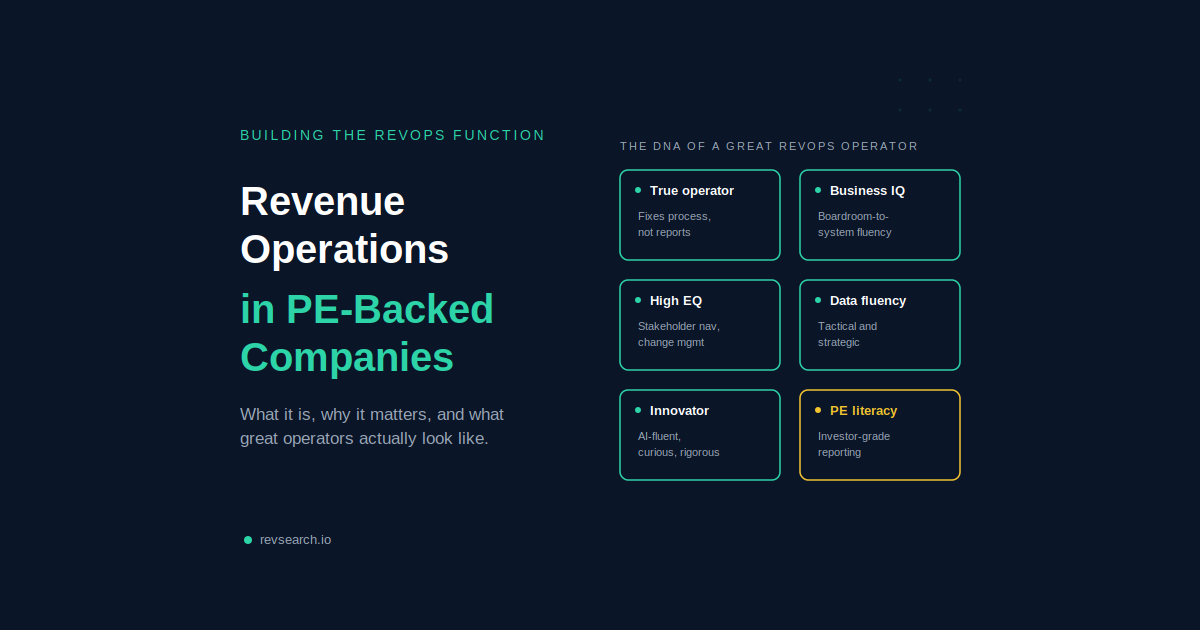
We've placed many RevOps leaders across all three stages of the build (Manager, Director, and VP) at PE-backed companies. You can read a few of their stories on our testimonials page. What's striking when you look at them side by side is how consistent the profile is across levels. The scope changes. The wiring doesn't. The Operator DNA stays true.
A few things separate the leaders who actually unlock this thesis from the ones who get bogged down:
They sit at the intersection of strategy, systems, and people and bring all three together. Strategy without systems is a deck. Systems without strategy is busywork. Either one without the people layer fails on contact with the org.
They lead with education, not mandates. Professionalizing a comp plan that's been based on gut feel for years. Rolling out a CRM migration to teams that didn't ask for it. Changing how reps get paid. Every one of these initiatives is emotional. The leaders who succeed build trust at the leadership level first, cascade messaging through managers, and sequence initiatives by emotional impact — quick wins before anything that touches a paycheck. That's change leadership, and it requires a level of EQ that doesn't always show up on a resume.
They're equally credible in the boardroom and the deal review. The same leader who can build a three-year operating model for the sponsor needs to be able to sit with a sales VP at 8 PM and pressure-test a forecast call. Most candidates can do one of those well. The thesis-critical hires can do both.
They've operated in PE before or they understand the cadence of it. The reporting rhythm, the QBR pressure, the diligence-readiness expectation, the way Operating Partners think about their portfolio. Leaders coming out of slow-moving enterprise environments often struggle with the velocity. This isn't disqualifying, but it's something to evaluate explicitly rather than assume away.
What to Look For When You're Hiring
A few signals we look for when evaluating RevOps leaders against a value creation thesis:
They can articulate the link between RevOps work and EBITDA, gross retention, or whatever the specific operational lever is (without prompting).
They have a clear point of view on the sequence: what comes first, what gets deferred, what's a year-two investment.
They've made unpopular decisions before. Comp plan rebuilds, territory shifts, pricing changes and they can describe how they built buy-in, not just what they decided.
They're comfortable with imperfect data. The fog is real, and the leaders who freeze waiting for clean inputs don't make it through the first hundred days.
They have a real perspective on what they would not do in the first six months. Restraint is as important as ambition at this stage.
The Board Meeting and the Hiring Team Are the Same Argument
The case for RevOps as a value creation lever and the case for a specific RevOps leader profile are not two arguments. They're the same argument made twice: once to your board, once to your hiring committee. If the board approves the strategic case but you hire a tactical operator, you've spent the political capital without buying the outcome.
The PE firms that are starting to treat RevOps as thesis-critical are also the ones getting deliberate about who fills the seat. The capability doesn't get created by the function. It gets created by the leader running the function. Finding that leader at the right stage of the build, with the right wiring for your specific thesis and culture — that's the work, and it's what we do.
These hires are worth the time it takes to get right.
For the broader portfolio-wide view of how PE firms are organizing around RevOps as an operational lever, see Why PE Firms Are Making RevOps a Portfolio-Wide Priority. For more on the talent profile and timing of the first hire, see When to Hire Your First RevOps Leader After Acquisition.
Frequently Asked Questions
-
RevOps owns the systems that produce clean forecasting data, defensible pipeline analytics, pricing and discounting governance, and comp plan design. Each of these directly affects the operational metrics — margin expansion, net retention, sales productivity — that PE sponsors underwrite in their investment thesis. When the function is run well, it converts strategy into measurable EBITDA impact rather than slideware.
-
Tie the function directly to the specific operational levers in the underwriting case. If the thesis was margin expansion, show how pricing architecture and deal desk discipline live in RevOps. If it was net retention, show how cohort visibility and customer success operations sit in the same function. Quantify the cost of the current operational fog — bad forecasts, leaky pricing, misaligned comp — and frame the investment as cost recovery, not cost addition.
-
A tactical RevOps leader optimizes systems, runs reports, and keeps the CRM clean. A strategic RevOps leader sits at the intersection of strategy, systems, and people. They design the operating model, build alignment across leadership, and translate sponsor expectations into operational execution. Both profiles exist. Hiring the first when you need the second is one of the more expensive misfires we see in PE portfolio companies.
-
Rarely well. A strong CRO is selling, building the team, managing top accounts, and representing the company externally. The skill set that makes someone a strong commercial leader is also rarely the operational architect skill set. The companies that try to consolidate the two roles usually end up with neither done at the level the value creation thesis requires.
-
The recruiters who are most useful in this space have direct, repeated experience placing RevOps leaders into PE-backed environments specifically — not generic SaaS, not enterprise tech, not stage-agnostic. They should be able to speak fluently about portfolio company cadence, value creation thesis alignment, and the difference between tactical and strategic RevOps profiles at each stage of the build. RevSearch focuses exclusively on this niche, which is why our pattern recognition on what works in this environment is sharper than a generalist firm's would be.