Business Acumen for RevOps Leaders: How to Tell If Your Next Hire Can Actually Hold Their Own in the Boardroom
In analytical functions, technical depth is what gets validated first. Years of CRM architecture. Forecasting models built and shipped. Comp plans owned end-to-end. SQL fluency. Tech stacks evaluated and deployed. The interview loop bends toward what the candidate has done with data, tech, and systems, because those are the things easiest to validate and most clearly tied to what the role looks like on paper.
That validation is necessary, but it isn't sufficient. The strongest RevOps leaders carry a capability that sits alongside the analytical chops and the tactical execution. They understand the business model first, and build everything else in context of it. They look at the company end-to-end. They make decisions with the full P&L in view, not just the slice of it that runs through the CRM. And they translate what the data is saying into the language the board, the OPs, and the C-suite are operating in.
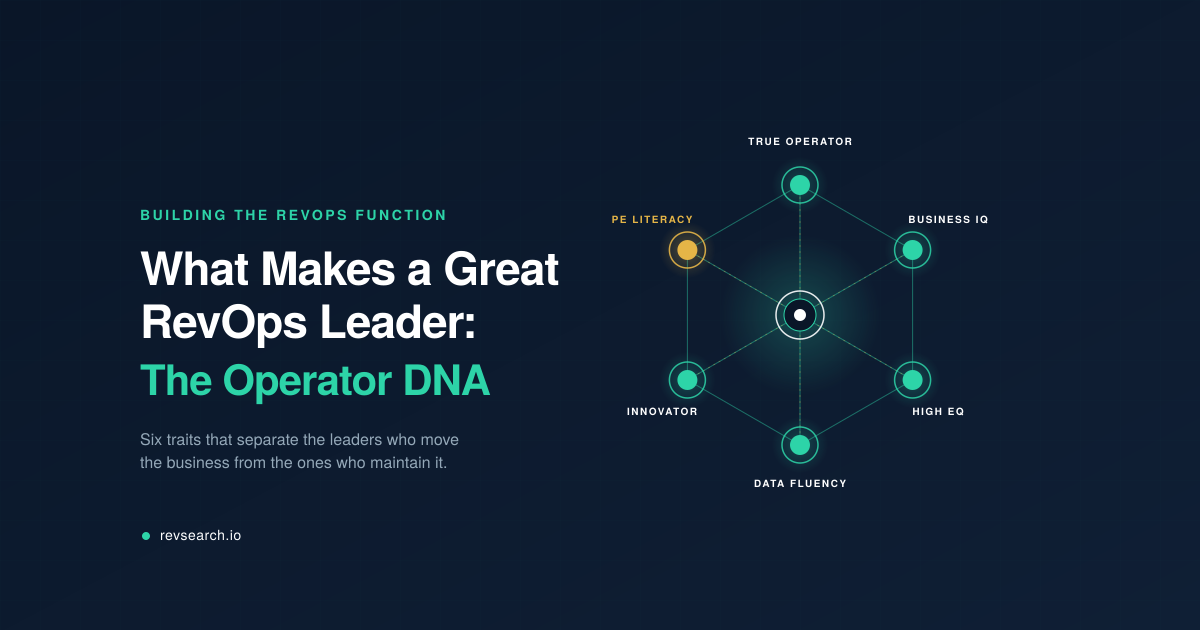
Business acumen for RevOps leaders is what the Operator DNA framework calls Business IQ. It's one of the six traits we look for when evaluating a strategic RevOps hire, and it's the trait that determines whether a leader earns the right-hand seat to the C-suite leader they report into, or whether work simply gets delegated to them. The Operator DNA pillar walks through the full set of six traits and how they relate to each other. This piece goes deep on what business acumen actually looks like in the seat, why it's harder to test for than the analytical and technical capabilities it sits next to, and how to evaluate for it deliberately rather than assuming it.
A leader can be analytically gifted and technically deep and still fail in a portfolio company seat if business acumen is missing, because everything they produce gets received as a report instead of a recommendation. The CFO has to translate them. The CRO has to interpret them. The operating partner walks out of the review uncertain whether the function is actually driving anything, because the person running it never connected the dots between their work and the business case.
Why business acumen is the trait that most often gets assumed instead of evaluated
A technical skill is straightforward to test. Walk a candidate through a CRM architecture question and the answer is right or wrong inside of five minutes. Ask them to model a comp plan and the structure either holds up or it doesn't. Hand them a messy dataset and the diagnosis they produce is concrete and gradable. Analytical and technical capabilities have natural test surfaces, and most RevOps interview loops are well-designed to find them.
Business acumen doesn't have a test surface that obvious. It shows up in how a candidate talks about a business they once worked in. It shows up in how they framed a decision they made eighteen months ago. It shows up in what they reach for when asked an open-ended question about what they accomplished in a prior role. None of those signals are gradable in the way a forecasting model is gradable. They require the interviewer to know what to listen for, to push past surface-level fluency, and to triangulate across multiple conversations. That work is harder than running a technical assessment, and it's the work most interview loops skip.
The result is a predictable hiring pattern. The technical and analytical bars are validated rigorously. The business acumen bar is assumed because the candidate sounded credible in the early conversations. Somewhere around month four post-hire, the hiring manager realizes the person they brought in is producing exactly the deliverables they were hired to produce, but those deliverables aren't connecting to anything the board recognizes as value. The pipeline reports are accurate. The forecast variance has narrowed. The dashboards are clean. None of it is moving the conversation the executive team is actually having.
That gap is the cost of treating business acumen as a side effect of analytical capability rather than as a distinct trait that requires its own evaluation. Both can coexist in the same leader. They are not produced by the same skill set, the same career path, or the same interview question.
What business acumen actually means for a RevOps leader
A RevOps leader with high business acumen does three specific things differently from a leader who only has analytical depth.
1. They start from the business model, not the revenue engine
The first move a high-business-acumen RevOps leader makes when they walk into a new company is to understand the business model. How does the company actually make money? What are the unit economics? Where do margins live and where do they leak? What does the cost structure look like across customer acquisition, delivery, and retention? What is the company's path to enterprise value at exit, and what has to be true about the revenue engine for that path to hold?
This sounds obvious. It is not what most do.
The default move for an analytically strong RevOps leader entering a new company is to dig into the revenue engine itself. Pipeline. Forecast. Conversion rates. Rep productivity. Stage definitions. Tooling. The work of cleaning up and instrumenting the revenue engine is real, and it has to happen. But a leader who starts there has implicitly made a choice to treat the revenue engine as a closed system, separate from the business it serves. Everything they build gets optimized for the revenue engine's own metrics, which may or may not be the metrics that matter to the business.
A leader with business acumen flips that order. They understand the business model first, and then they instrument the revenue engine in service of it. The pipeline definition is shaped by what the company is actually trying to sell and to whom. The forecasting methodology is shaped by what the CFO needs to manage cash and what the sponsor needs to underwrite the next stage of the plan. The KPIs are shaped by what actually moves enterprise value, not by what's easy to measure. The work looks similar from the outside, but the hierarchy of decisions underneath it is fundamentally different.
The signal we look for: when you ask a candidate what they did first in their last role, do they describe learning the business or do they describe auditing the systems. Both answers are credible on the surface. Only the first answer comes from a leader who's going to build the right thing for this specific company.
2. They look at the business end-to-end
A RevOps leader with business acumen sees the company as a single system that includes finance, product, customer success, marketing, and sales, all connected by the same revenue cycle. They don't treat the revenue engine as their lane and everything else as someone else's problem. They understand that a CAC payback issue is a marketing problem and a product problem and a comp problem at the same time. They understand that a forecast miss can be a CS problem before it's a sales problem if expansion was overweighted. They understand that a pricing change has implications for the deal desk, the comp plan, the forecast model, and the customer success motion, and they can think through all of those second-order effects before the change ships.
This end-to-end view is the difference between a RevOps leader who optimizes their own function and a RevOps leader who improves the business. The first looks pretty. But, the second is truly valuable to the business and earns the seat at the executive table.
In practice, this shows up most clearly in how a candidate talks about cross-functional work. A leader without end-to-end fluency describes cross-functional work broadly as "alignment" and "communication." A leader with end-to-end fluency describes it as the actual mechanics of how a decision in one function shows up in another. They can walk you through how a change in the ICP definition flows through to marketing's targeting, sales's segmentation, the comp plan's accelerators, the deal desk's discount thresholds, and customer success's onboarding capacity. Same word, completely different depth of understanding underneath it.
The signal we look for: ask a candidate to walk you through a cross-functional initiative they led, and listen for whether they describe the connections between functions or just the activities within their own. The leaders who can map the system are the ones who can change it.
3. They translate revenue into the language of the boardroom
This is the component that most often determines whether a RevOps leader survives their first board meeting or operating partner review.
A RevOps leader with high business acumen understands that the audience changes the deliverable. The same pipeline data presented to the CRO is a different artifact than the same pipeline data presented to the board. The CRO wants to know what's at risk this quarter, where the gaps are, and what to do about them. The board wants to know what the trajectory implies for the value creation thesis, what the variance from plan tells them about the durability of the growth, and what the leading indicators say about the next two to four quarters. A leader who presents the same pipeline review to both audiences is doing one of those audiences a disservice, and usually both.
The translation work is the work. A great RevOps leader can take a pipeline anomaly and explain what it means for net revenue retention, EBITDA, and the value creation timeline. They can take a forecasting model and explain how its assumptions connect to the cash position the CFO is managing. They can take a comp plan change and explain how it shapes the rep behavior the board is implicitly underwriting when they approve the operating plan. They are bilingual in revenue mechanics and business outcomes, and they can move between the two languages in a single sentence.
A recent RevSearch placement at a $150M+ SaaS and hardware company illustrates this well. When the new VP of RevOps joined in late 2023, the company was producing a single executive deck that tried to serve every audience at once. A new leader joined the team, looked at the deck, and asked how anyone was supposed to get through it in fifteen minutes. The VP’s response was to build out distinct reporting tiers for distinct audiences: what the board needs to see, what the leadership team needs to see, what the broader company needs to see, what the reps need to see, and what RevOps needs to see internally. Same underlying data foundation. Five different lenses on top of it, each one shaped to the decision the audience is actually making. The work that made that restructuring possible wasn't the reporting itself. It was knowing what each audience actually needed in order to make a decision and move the business forward. That's the translation layer in practice. The leaders who understand it intuitively don't produce one deck and adapt it. They produce different artifacts for different decisions, because they understand that the audience is part of the deliverable.
This is also where business acumen connects most directly to the EQ pillar of the Operator DNA. The translation work requires not just knowing what the board wants to hear, but picking up on what the room is actually asking for in the moment and adjusting the framing accordingly. The two traits are distinct, but they reinforce each other. A leader with business acumen and weak EQ will have the right substance and the wrong delivery. A leader with strong EQ and no business acumen will have the right delivery and nothing of substance to deliver. The leaders who carry both walk into a board review with the credibility to actually shape what gets discussed.
The signal we look for: when a candidate describes a past initiative, ask them how they would have framed it for the board versus for the CRO. Strong candidates produce two materially different framings within the same answer. Weaker candidates produce the same content delivered with slightly different word choice, which is a signal that they're describing the work but not actually thinking in the audience's language.
How business acumen is distinct from data fluency in a RevOps leader
The most common diagnostic mistake hiring teams make is assuming that a candidate who is strong on data fluency is also strong on business acumen. The traits coexist in the strongest leaders, but they are produced by different instincts and they break down differently when one is missing.
A leader with high data fluency and weak business acumen produces accurate analysis that doesn't connect to anything the business can act on. The forecasting model is sound. The pipeline cuts are clean. The variance analysis is rigorous. None of it is anchored in what the business is actually trying to accomplish, because the leader is operating from inside the data, not from inside the business model. The output is a deliverable but it rarely becomes a decision.
A leader with strong business acumen and weak data fluency has the opposite problem. They understand the business well, they ask the right questions, they frame the right priorities. But their analysis can't survive contact with rigor. They miss the second-order effects in the data because they don't know how to query for them. They get caught flat-footed when an operating partner or a CFO digs into the methodology behind a recommendation. The instinct is right. The substance underneath the instinct isn't dense enough to hold up under pressure.
The leaders who succeed in PE-backed RevOps seats have both the strategic point of view and the analytical chops and the two traits compound. The business acumen tells the leader which questions are worth asking. The data fluency lets them answer those questions in a way that withstands scrutiny. Either one alone produces an uneven outcome.
The reason this matters at the hiring stage is that the two traits look similar in casual conversation. Both produce candidates who can talk fluently about strategy, the revenue engine, and what's working in the business. The difference shows up when the interviewer pushes on either side. Push on the business model and the leader without business acumen starts to thin out. Push on the data and the leader without data fluency starts to wave at specifics. The push is the diagnostic and the interview loops need to be designed to do it deliberately.
Why business acumen for RevOps leaders is becoming more consequential, not less
The case for business acumen has been true since the function was named. And, currently, it is being sharpened by a couple of dynamics.
The argument we keep returning to with our PE clients is that AI is rapidly compressing the time and effort required to produce the kind of pipeline analysis, forecast modeling, and operational reporting that has historically defined the RevOps deliverable. The analytical work isn't going away, but it is becoming a faster and cheaper input to a decision rather than the decision itself. The differentiating capability of a RevOps leader is increasingly the judgment layer on top of the analysis. What does this insight actually mean for the business? What should we do about it? How does it connect to the value creation thesis the board is operating against?
AI is an accelerant, not a replacement for human judgment. It can automate your forecasting overlay. Build the model. Clean up the billing reconciliation. But it can't tell you why your pipeline is broken. It can't diagnose the incentive structure that's quietly destroying your margins. It can't question the assumption. It can't sit in front of a PE partner and defend the number. That takes an architect. That work belongs to humans, and the quality of that work depends on the business acumen of the leader doing it.
The leaders with business acumen know what to point AI tools at, because they understand the business well enough to identify the questions worth answering. They know how to defend the output, because they can connect a number to a business case in real time. They know which AI-generated recommendation to ship and which to question, because they have the judgment that the tool itself doesn't.
There's a second-order effect worth naming. Operating partners are pushing for faster commercial transformation, faster systems standardization, faster pipeline credibility. There's less room than there used to be for a RevOps leader who needs eighteen months to develop business fluency on the job. The leaders who arrive with business acumen already in the profile compress the ramp. The leaders who arrive without it absorb the cost of that gap into the value creation timeline, which is a cost the sponsor and the executive team end up paying.
Both dynamics are pushing in the same direction. Business acumen for RevOps leaders is moving from a differentiator at the senior end of the market to a baseline expectation across most of it.
How to evaluate for business acumen in a RevOps hire
The three components map cleanly onto an interview approach. Ask a question for each component, listen for the specific signals, and triangulate from there.
For the business-model-first instinct: ask the candidate to walk you through how they approached their first 90 days in their last role. Strong candidates spend meaningful time on what they learned about the business itself, the customer, the unit economics, before describing what they built or fixed. Weaker candidates describe an audit of the systems and a list of projects they shipped. The first answer is from a leader who builds in context. The second is from a leader who builds what they know how to build.
For the end-to-end view: ask the candidate to describe a cross-functional initiative they led, and specifically how a decision in one function flowed through to the others. Strong candidates can map the second-order effects across two or three other functions in concrete detail. Weaker candidates describe the activity in their own function and reference the others generically. The depth of the answer tells you how the candidate actually thinks about the business.
For the translation layer: ask the candidate to describe how they presented a single piece of work to two different audiences, ideally the CRO and the board or the sponsor. Strong candidates describe two materially different framings, with different metrics emphasized, different time horizons, and different decisions being asked for. Weaker candidates describe the same content delivered with slightly different language. The first answer is from a leader who is genuinely bilingual. The second is from a leader who has only learned one of the two languages.
The trait that earns the seat at the table
A RevOps leader who carries business acumen earns the right-hand seat to the C-suite leader they report into, which means they get pulled into strategic conversations early when decisions are cheapest to shape. A RevOps leader without it gets handed decisions after they've been made, which limits their work to instrumentation and execution of someone else's strategy. The first leader builds a function that compounds. The second leader runs a function that costs.
For PE-backed companies in particular, where every quarter of the hold period is doing strategic work, the cost of hiring a RevOps leader without business acumen is the cost of a function that runs alongside the value creation plan rather than driving it forward. That cost tends to be invisible until late, because the work itself looks fine but it’s not moving the needle.
At RevSearch, business acumen is built into how we screen every RevOps candidate we present. It shows up in how we structure the interview conversations, in how a candidate presents their findings from our data assessment, in the questions we ask references, and in the lens we bring to every shortlist we build for our clients.
Frequently asked questions
-
Technical and analytical capabilities have natural test surfaces. A Salesforce architecture question is right or wrong inside of five minutes. A comp model either holds up or it doesn't. Business acumen doesn't grade that cleanly. It shows up in how a candidate frames a decision, how they describe a business they once worked in, what they reach for when asked an open-ended question about prior outcomes. Most interview loops are well-designed to evaluate the technical and analytical bars and end up assuming the business acumen bar because the candidate sounded credible in the early conversations. The hiring miss tends to surface around month four, when the deliverables are clean but the function isn't moving the conversation the executive team is having.
-
Data fluency is the ability to query, structure, and interpret data accurately. Business acumen is the ability to connect what the data says to what the business is actually trying to accomplish. The two traits look similar in interviews but produce very different leaders in the seat. A leader with high data fluency and weak business acumen produces accurate analysis that doesn't drive decisions. A leader with strong business acumen and weak data fluency produces strategic instinct that doesn't survive scrutiny. The strongest RevOps leaders have both, and most interview loops are designed to test the first while assuming the second.
-
The trait is partially developable, but the timeline is the issue. PE hold periods are compressing, and the patience for an eighteen-month ramp on business fluency has narrowed considerably. A strong analytical RevOps leader from a non-strategic background can develop business acumen, but the cost of that development tends to be absorbed by the value creation timeline. For most portfolio searches, we recommend hiring candidates who already carry the trait, especially for first RevOps leader roles where the leader's framing of the function will set the ceiling for everything that follows.
-
PE literacy is the specific application of business acumen to the dynamics of a PE-backed environment: what sponsors care about, how operating partners evaluate progress, what investor-grade reporting looks like, how value creation timelines shape near-term priorities. A leader can have strong business acumen developed in a non-PE setting and still need to build PE literacy on the job. The reverse is rare. PE literacy without underlying business acumen tends to produce a leader who knows what to say to a sponsor without understanding what's actually true about the business, and that gap shows up the first time the conversation goes off-script.