
EQ in RevOps: The Soft Skills That Make a Transformational Leader
In analytical functions, "soft skill" tends to get filed under "nice to have." The phrase itself does the damage. Soft sounds like optional. Soft sounds like the part of the candidate profile you can develop later, after you've validated the technical chops and the data fluency and the systems thinking. Soft sounds like the part of the work that doesn't move numbers.
That bias runs especially deep in PE-backed environments, where the hiring conversation tends to default to quantitative signals. Years of operating experience. Tools they've stood up. Forecast accuracy they've delivered. ARR they've worked under. Those are the easy things to validate, and they're real. But they're not the things that quietly determine whether a RevOps hire actually drives change at the company.
The trait that does that, more than any other, is EQ. And the case for EQ in a RevOps leader has nothing to do with being agreeable, being warm, or being good in a meeting. It has to do with what EQ actually produces: change that lands, adoption that sticks, trust that lets a leader push back on the status quo, and the credibility to translate across a CRO, a CFO, and an operating partner who all want different things from the same set of numbers.
Soft does not equal lesser. In RevOps, the soft skills are the ones doing the heaviest lifting.
Why EQ gets underweighted in RevOps hiring
RevOps is a function that selects for analytical capability at every step of its development. Most leaders come up through sales operations, finance, or strategy roles where the deliverable is a model, a dashboard, or a system. Those backgrounds reward people who can produce clean outputs. They don't necessarily reward people who can navigate the human dynamics that determine whether those outputs actually change behavior.
So the typical RevOps hiring conversation tilts toward what's easiest to validate. Did they build the forecasting model? Yes or no. Did they own the comp plan? Yes or no. Have they worked in a PE-backed company? Yes or no. The answers are clean and resume-readable. They produce a candidate slate that looks technically credible.
But the technically credible candidate is not always the one who moves the business. We've placed enough RevOps leaders to know the pattern. The candidates who have the technical capability but lack the EQ produce a year of clean systems, on-time reports, and a business that hasn't actually changed shape. The work was right. The way they delivered it wasn't. They didn't bring stakeholders along. They didn't earn the right to push back on legacy process. They didn't pick up on the political signal that a forecasting change was going to land badly with the CRO. So the work shipped, and the organization quietly worked around it.
That's the cost of underweighting EQ in this hire. It doesn't show up as a failed hire. It shows up as a function that runs but doesn't move.
What EQ actually does in a RevOps seat
The most useful way to think about EQ is as four connected competencies rather than as a single trait. The widely cited four-domain model splits EQ across two axes. Personal competence covers what you see in yourself and what you do about it. Social competence covers what you see in others and what you do about it. The four quadrants are Self-Awareness, Self-Management, Social Awareness, and Relationship Management.
In a RevOps seat, each of these does specific work.
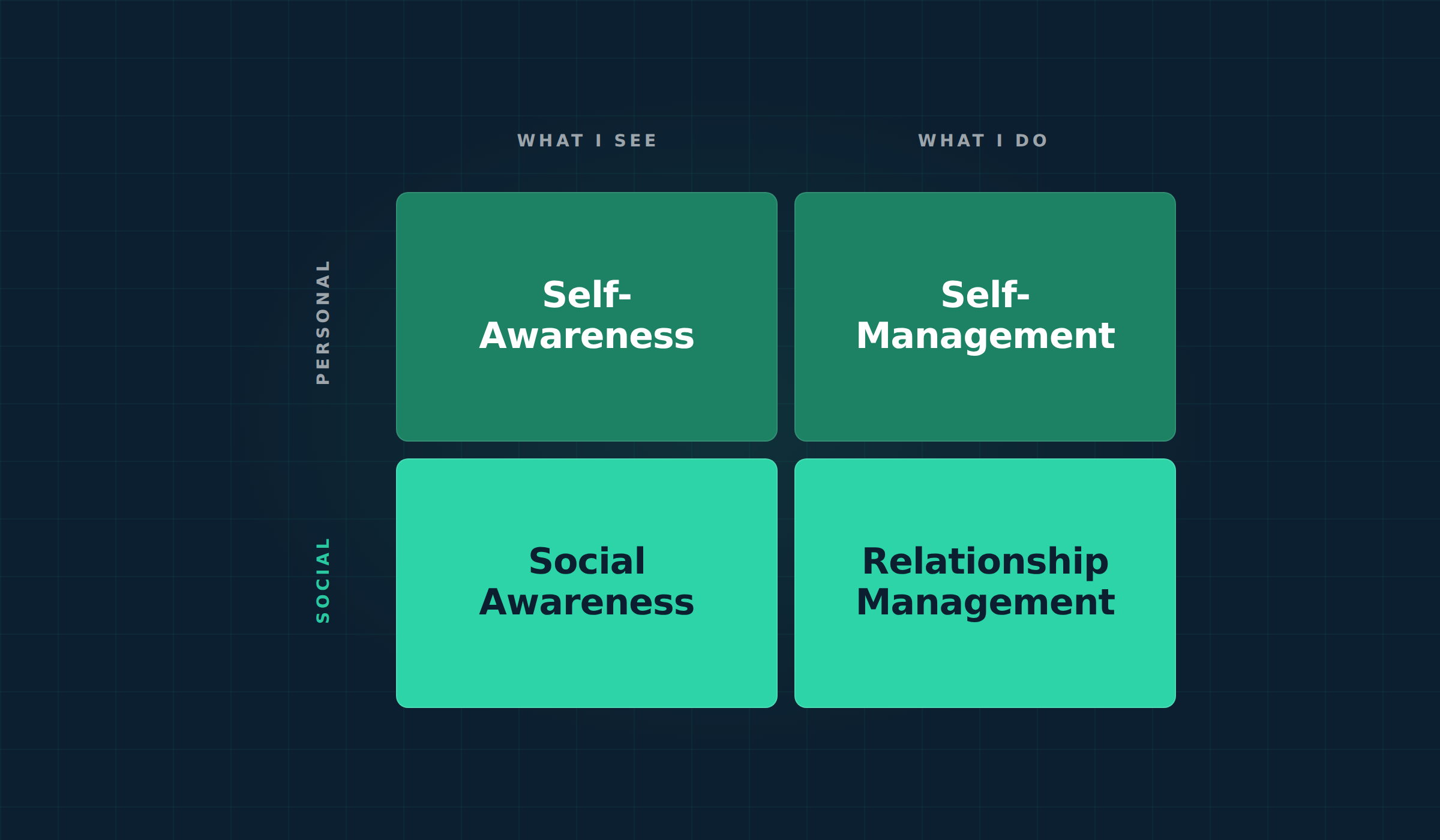
Self-Awareness: knowing when your default move is the right or the wrong move
The strongest RevOps leaders know their own bias toward action. The default operator instinct is to fix the system, ship the dashboard, build the model. That instinct is correct most of the time. It's wrong some of the time, and self-aware leaders know the difference.
A self-aware RevOps leader knows when they're over-indexing on data and missing the human signal in the room. They know when a stakeholder's resistance to a process change isn't about the process at all but about the loss of control the change implies. "They know which of their own reflexes serve the business and which ones serve their own preference for clean systems over messy reality. This is the difference betweenan operator who diagnoses the root issue and an order-taker who fixes the dashboard. They know when they're being captured by one stakeholder's worldview at the expense of the others, and they can correct for it before the work tilts in a direction that costs them credibility somewhere else.
Self-awareness is what makes a RevOps leader credible across the executive team rather than aligned to one corner of it. It's the prerequisite to everything else in the model.
Self-Management: the composure to not react
RevOps leaders sit at the intersection of every stressed-out function in the business. Sales is chasing quota. Finance is chasing the number. Marketing is chasing pipeline. Customer success is chasing retention. Every one of those teams has a question for RevOps, and most of those questions arrive in the form of frustration.
Self-management is the discipline to not absorb that stress and amplify it. It's the patience to let a new comp plan land for two weeks before defending the rationale. It's the composure to take a hostile question from a sales leader in a QBR without escalating into a defensive response that turns a conversation into a confrontation. It's the discipline to not react to a bad forecast call in the moment, because the right response is rarely the immediate one.
The RevOps leaders who lack this capability are the ones who get pulled into every fire. They're constantly defending the function instead of advancing it. The leaders who have it operate at a different altitude. They get more done because they spend less energy managing the politics of getting the work done.
Social Awareness: reading the room before you ship the change
Social awareness is the capability that quietly determines whether a change initiative succeeds or fails. It's the work of reading what's actually happening in the room: where the political resistance is going to come from, what's not being said, what each stakeholder is privately optimizing for that they won't put in writing.
Most RevOps work is change work. New process. New data definitions. New comp structure. New pipeline rules. Every one of those changes has political weight, and a RevOps leader who can't read the political weight before shipping the change is going to spend the next quarter wondering why adoption is so poor.
A socially aware RevOps leader knows that the CRO is going to push back on a pipeline definition change because of where it lands them on their forecast accuracy this quarter, even if the CRO will never say so out loud. They pick up on the CFO's discomfort with a forecasting model that doesn't match how the CFO thinks about cash, even when the model is technically correct. They notice the operating partner's body language during the metric review and adjust the next conversation accordingly. They walk into a stakeholder meeting having already mapped where the friction is, and they design the rollout to address that friction before it surfaces.
This is the capability that converts a smart change into an adopted change. It's the difference between a comp plan that gets implemented and a comp plan that gets worked around.
Relationship Management: the work of building trust and driving influence
This is the quadrant where change management actually lives. And it's where one of the most consequential capabilities in the Operator DNA shows up: the ability to challenge the way we've always done it in a way that builds trust and drives influence rather than defensiveness.
That capability is not innate. It's earned. It comes from a leader who has put in the work of building credibility with each stakeholder, understanding their incentives, learning where they need to be brought along and where they can be pushed, and then using that earned trust to advocate for change. A RevOps leader without relationship management capability can have the best ideas in the room and still lose every fight, because trust is the currency of organizational change and they haven't built any.
The leaders who excel here are the ones who have invested in relationships before they needed them. They've spent time understanding the CRO's quarterly pressure points before they show up asking for a forecasting change. They've built credibility with the CFO on the small things before they ask for budget on the big things. They've earned the right to disagree because they've demonstrated they understand the business well enough to be worth disagreeing with.
Relationship management is what turns insight into impact. Without it, the analytical capability and the strategic recommendations and the systems thinking all sit in a deck that nobody acts on.
The four are a chain, not a list
The most important thing to understand about this model is that the four competencies are sequential. Self-awareness is the prerequisite to self-management. You can't manage what you can't see in yourself. Social awareness is the prerequisite to relationship management. You can't navigate a stakeholder you can't read. A leader can have one or two of these capabilities and still produce uneven outcomes. The leaders who actually move the business have all four, and they have them in the right order.
That sequence is the reason EQ shows up so often as the variable that explains why a strong-on-paper RevOps hire didn't perform. The technical capability was there. One link in the chain wasn't.
Why AI is sharpening the case for EQ
The argument for EQ in a RevOps leader has been true for as long as RevOps has existed. AI is making it more true, not less.
The reason is straightforward. AI is rapidly commoditizing the analytical layer of RevOps work: surfacing patterns in data, generating summaries of what's happening across the funnel, drafting talking points for a QBR, modeling out the impact of a comp change. The information-gathering layer is getting cheaper and faster across every PE-backed company that's investing in it. That's a good thing for the function and for the business.
What's not getting commoditized is judgment. Dr. Travis Bradberry, the world's leading expert on emotional intelligence and author of Emotional Intelligence 2.0 and the 2025 follow-up The New Emotional Intelligence, puts it directly:"Good decisions require far more than factual knowledge. They are made using self-knowledge and emotional mastery when they're needed most." That distinction is exactly the one widening across PE-backed companies right now. AI floods the organization with factual knowledge. The decisions still belong to humans, and the quality of those decisions depends on the EQ of the people making them.
This is where the case for EQ in a RevOps leader gets sharper, not the other way around. As more analytical capability gets pushed onto AI tools, the differentiating skill of a RevOps leader is no longer the analysis itself. It's the judgment of which analysis to trust, the social awareness to know which insight is going to land badly with a stakeholder before it ships, and the relationship management to convert AI-generated output into adopted change. As one industry observer recently put it, output without judgment is just noise at scale.
There's a second-order effect worth naming. Organizations that adopt AI faster than their people can absorb the change create what one commentator described as brittle systems, systems that move quickly but can't bend without breaking. The RevOps leader who pushes AI tooling into a sales team without the EQ to manage how that team experiences the change ends up with adoption problems that look technical but are actually emotional. The data flows. The behavior doesn't change. The leader spends the next quarter defending the rollout instead of advancing the business.
The leaders who avoid this trap are the ones who carry enough EQ to set the cultural permission for how their organizations absorb AI. They model the discipline of using AI to augment judgment rather than replace it. They protect the human bandwidth required to actually adopt the changes their tools are enabling. And they hold the trust required to push the organization forward at the pace it can actually move, rather than the pace the technology suggests is possible.
That capability has always mattered. AI is just making the gap between leaders who have it and leaders who don't more visible, and more expensive.
How to evaluate for EQ in a RevOps hire
The four-quadrant model is also the most useful frame for actually evaluating EQ in a candidate. Generic interview questions about communication style and stakeholder management produce generic answers. Asking the candidate to demonstrate each of the four capabilities produces signal.
For Self-Awareness: ask the candidate to describe a specific decision they made in a prior role that they would now make differently, and why. Listen for whether they can name their own bias, their own miscalculation, or their own blind spot in concrete terms. Strong candidates can identify the specific dynamic they missed and what they've changed in how they operate as a result. Weaker candidates either can't surface a real example or default to circumstantial explanations that don't implicate their own judgment.
For Self-Management: ask the candidate to walk you through a moment of significant pushback or hostility from a senior stakeholder, and how they handled it in real time. Listen for composure. Listen for whether they describe the response as a reaction or as a deliberate choice. Strong candidates describe pausing, recalibrating, choosing a path. Weaker candidates describe defending themselves, which is a signal that the stress went straight through them.
For Social Awareness: ask the candidate to describe a stakeholder they had to bring along on a difficult change, and what they had to learn about that person's incentives before the conversation went anywhere. Strong candidates describe the stakeholder specifically. They reference what the person was privately optimizing for, what they were measured on, what their professional pressure points were. Weaker candidates describe the stakeholder as a generic obstacle, or don't reference stakeholders at all.
For Relationship Management: ask the candidate for an example of when they had to challenge a senior stakeholder on a decision they disagreed with. Listen for whether they describe building trust before the disagreement, framing the disagreement in terms of the stakeholder's interests, and following through after the disagreement to preserve the relationship. Strong candidates describe disagreement as something earned through prior credibility and managed with care. Weaker candidates describe it as confrontation, or describe avoiding it.
The pattern across all four questions is the same. Strong EQ candidates describe people specifically and describe themselves with self-implication. Weaker EQ candidates describe people generically and describe themselves as the protagonist who was right all along. The first set becomes the leader who moves the business. The second set becomes the leader who runs the function.
The trait that decides whether the work lands
The case for EQ in a RevOps leader is not a sentimental one. But it’s about change management requiring social awareness. Trust requiring relationship management. Credibility across the executive team requiring self-awareness and self-management. And every other trait in the Operator DNA, the systems thinking, the business IQ, the data fluency, the innovator's mindset, compounding by the EQ underneath it.
In RevOps, the soft skills are doing the work that determines whether the function moves the business or merely runs alongside it. Hire for them deliberately, evaluate for them rigorously, and treat them with the seriousness they actually deserve.
For a fuller view of how EQ fits alongside the other traits that distinguish great RevOps leaders, our pillar piece What Makes a Great RevOps Leader: The Operator DNA walks through the full six-trait framework and how to evaluate for each one in candidates.
At RevSearch, the EQ assessment is built into how we evaluate every RevOps candidate we present. It's not a separate step. It's part of the lens we bring to every conversation, every reference call, and every shortlist we build for our clients.
Frequently asked questions
-
Most RevOps work is change work: new processes, new data definitions, new comp structures, new pipeline rules. EQ is what determines whether those changes get adopted or quietly worked around. A leader with strong technical capability and weak EQ produces clean systems and accurate reports while the business stays the same shape, because stakeholders were never brought along. In practice, EQ produces the trust that lets a RevOps leader push back on legacy process and the credibility to translate across a CRO, a CFO, and an operating partner who all want different things from the same numbers.
-
The widely used four-domain model splits EQ into self-awareness, self-management, social awareness, and relationship management. In a RevOps context, self-awareness is knowing when the default instinct to fix the system is the wrong move. Self-management is the composure to absorb stress from every function without amplifying it. Social awareness is reading the political weight of a change before shipping it. Relationship management is the earned trust that turns insight into adopted change. The four operate as a chain, with each one a prerequisite for the next.
-
Ask for demonstrations of each of the four competencies rather than generic questions about communication style. Ask for a decision they would now make differently (self-awareness), a moment of hostility from a senior stakeholder and how they handled it in real time (self-management), a stakeholder they had to bring along and what they learned about that person's incentives first (social awareness), and a time they challenged a senior leader on a decision they disagreed with (relationship management). Strong candidates describe people specifically and implicate their own judgment. Weaker candidates describe people generically and cast themselves as the protagonist who was right all along.
-
More. AI is commoditizing the analytical layer of RevOps work: pattern surfacing, summaries, modeling, and drafting. What it does not commoditize is judgment. Which analysis to trust, which insight will land badly with a stakeholder, and how to convert output into adopted change all still belong to the leader. As analytical capability gets cheaper and faster, the differentiating skill of a RevOps leader shifts toward the EQ that governs how those insights get absorbed by the organization.
