
The question most executives search isn't "what's the difference between Sales Ops and RevOps." It's "which one do I need to hire right now?" Those are not the same question, and answering the first one well doesn't actually answer the second.
Here's the short version. Sales Operations is a component function within Revenue Operations. RevOps is the broader operating system that aligns sales, marketing, and customer success around shared data, shared processes, and shared accountability for revenue. SalesOps sits inside that scope, focused specifically on the sales engine. One is a subset of the other.
The confusion matters because the conflation between these two scopes shows up as a specific, recurring hiring mistake. We see it most often at the exact moment companies can least afford it: the first 100 days after a private equity acquisition, or the transition from Series B growth into scaled execution. A company decides it needs RevOps, writes a job description for a SalesOps leader, hires a strong one, and then wonders eighteen months later why the revenue engine still leaks at the handoffs.
This is an article about the scope distinction and the hiring decision it forces. It's written for the CRO, CFO, or CCO making that call, and for the RevOps leader who needs to frame it clearly for their exec team.
The scope of each function, defined cleanly
What SalesOps owns
SalesOps is the operating function for the sales team. Its scope is focused and deep. A SalesOps leader owns the systems, processes, and reporting that let sales reps sell efficiently and let sales leadership manage the business. In practice, that means pipeline management and CRM workflows, deal desk and deal support, territory design and territory operations, quota and comp plan modeling, rep-level reporting, sales process governance, and the analytics that sit under the weekly sales leadership cadence. As the sales org scales into multiple segments and overlays, SalesOps also carries responsibility for the pipeline cadences and CRM hygiene that keep the business reportable.
Good SalesOps creates a clean sales motion. Reps spend less time on admin, forecasts get more accurate, comp plans reward the right behavior, and sales leaders have the data to run the business. It's a discipline with real depth and real craft, and a strong SalesOps leader is a significant asset to any revenue organization.
What RevOps owns
RevOps operates at a broader altitude. Its scope is the full revenue engine, which means the combined operating system across sales, marketing, and customer success. A RevOps leader owns cross-functional process design, unified data architecture, full-funnel reporting, and the governance that keeps marketing, sales, and customer success operating against a shared set of definitions and a shared view of the customer.
In practical terms, RevOps owns the handoffs. How marketing-qualified leads convert to sales-qualified opportunities. How closed-won deals move into customer success with clean data and clean context. How renewal and expansion signals flow back into the funnel. How the revenue forecast incorporates inputs from all three teams, not just one. RevOps is the function that makes the revenue engine operate as one system rather than three adjacent ones.
How they relate
The cleanest way to think about it: SalesOps is one of the functional areas RevOps orchestrates. MarketingOps is another. Customer Success Ops is a third. At scale, these are distinct teams with their own specialized talent. In smaller organizations, they may be one person wearing multiple hats. Either way, the architectural relationship is the same. SalesOps is a sub-function within the broader RevOps scope.
This is the part of the conversation that gets skipped in most explainers, and it's the part that determines whether a hiring decision is going to work.
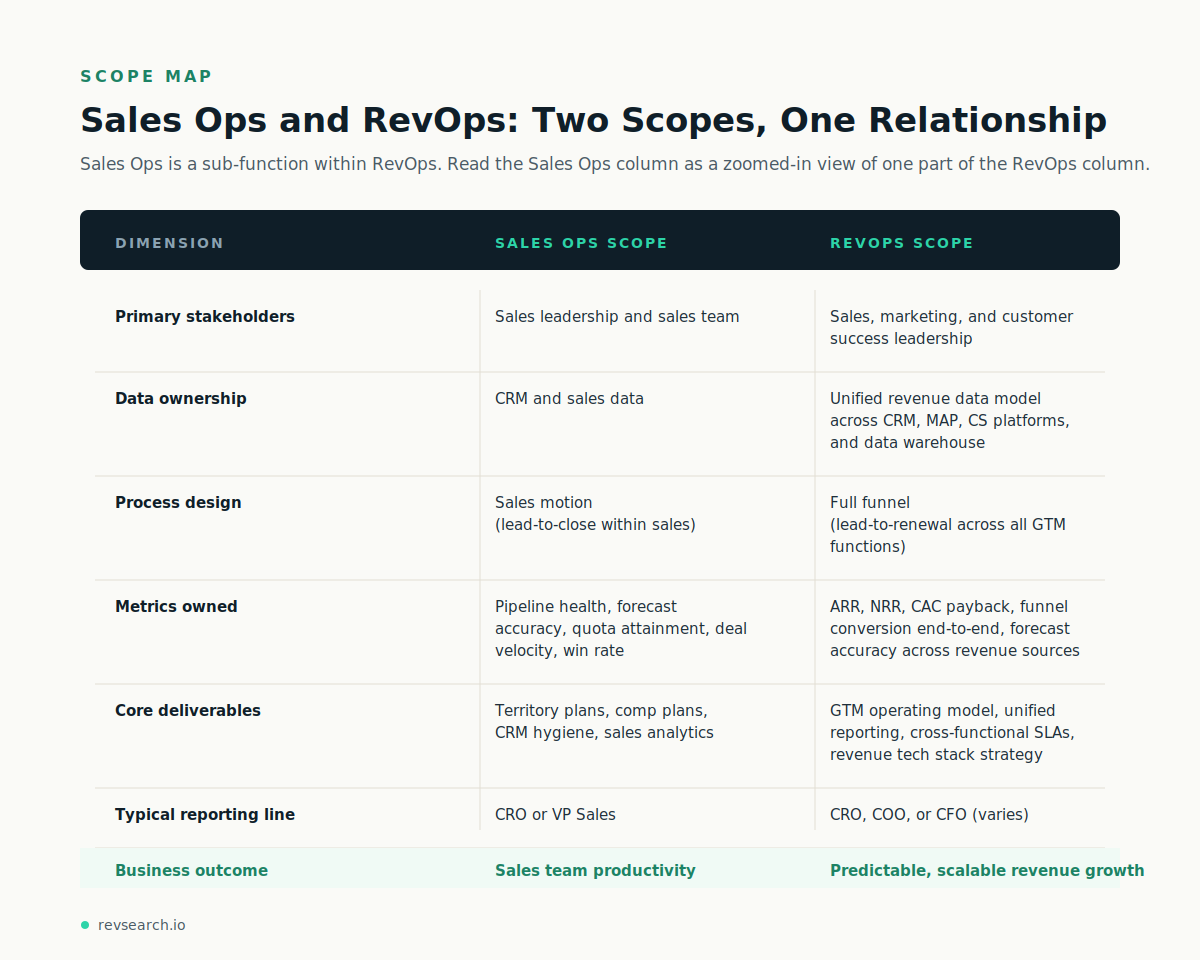
Sales Ops owns the sales motion. RevOps owns the full revenue engine across sales, marketing, and customer success.
The table above is not a competition. It's a scope map. Read the SalesOps column as a zoomed-in view of one part of the RevOps column.
Why the distinction matters now
Two things have changed in the last five years, and together they've raised the stakes on getting this hiring decision right.
The first is market adoption. Gartner predicted in 2021 that 75% of the highest-growth companies would deploy a RevOps model by 2025. Whether or not the exact timeline held, the direction is settled, and the companies winning in their categories are operating with a formal RevOps function, not a collection of adjacent ops teams.
The second is the evidence that alignment actually moves the business. Forrester research from Nancy Maluso found that emerging companies in the prepare-for-exit stage that align people, process, and technology across their revenue engine experience 36% more revenue growth and up to 28% more profitability than those that don't. The "Rise of RevOps" study commissioned by Salesforce from Forrester Consulting found that at the time of survey, 32% of companies had a single person accountable for revenue growth across every channel, with 89% planning to have that role within two years.
For a PE sponsor or a portco board, the translation is direct. This is no longer an optional investment or a nice-to-have operating upgrade. It's a structural piece of the value creation thesis, and it's an operating decision with compounding consequences over a 6+ year hold. Get the first hire right and the revenue engine gets more predictable every quarter. Get it wrong and the org is still patching handoff leaks two years later.
The hiring mistake we keep seeing
Across the RevOps searches we run at RevSearch, one pattern surfaces more than any other. A company decides it needs RevOps. The job description gets written. When you read it carefully, it's a SalesOps job description with the title changed. The scope described is the sales motion: CRM, pipeline, forecast, comp, territories. The candidates that get interviewed are strong SalesOps leaders. The company hires one of them.
Eighteen months in, the picture looks like this. The CRM is cleaner than it's ever been. Forecasts are more accurate. The sales team has clearer territories, better comp plan clarity, and tighter weekly reporting. All real wins, all directly attributable to the hire.
And yet the structural problems haven't moved. The handoffs are still broken. Marketing is still arguing with sales over lead quality, customer success is still operating off a different data set than sales, and renewal and expansion forecasts are still assembled by hand in a spreadsheet because the systems don't talk. There's no unified revenue number the leadership team trusts; marketing, sales, and CS each report their own metrics and someone has to reconcile them by hand before every board meeting. GTM planning still happens inside each function rather than across them, so annual planning produces three plans that don't reconcile. The tech stack grew wherever each function had budget, with no one owning the architecture, so integration debt is now its own line item. The revenue number still surprises the board twice a year. Nothing about the problems that motivated the hire in the first place has actually changed.
The failure here is not in the person. The hire delivered against their actual scope, and delivered well. The failure is in the scope the company was hiring for. They needed RevOps. They hired SalesOps. The result is that marketing and customer success stayed in the dark, which is the exact opposite of what RevOps is supposed to solve. A single SalesOps hire, no matter how strong, cannot architect a system across three functions that don't report to them.
This is why framing SalesOps and RevOps as a "versus" choice is unhelpful. The question isn't which function is better. The question is which scope your organization is actually trying to hire for, and whether the candidate profile you're evaluating matches that scope.
How to tell which hire your org actually needs
The right first hire depends on stage, complexity, and what the business is trying to unlock. A few patterns we see consistently across portfolio companies:
Lower middle market ($10M–$100M revenue): At this stage, the RevOps team is typically one or two strategic ICs with a director-level lead, and SalesOps responsibilities are usually absorbed directly into the RevOps Lead's scope, often 60 to 70% of their time. Marketing Ops and CS Ops, if they exist at all, still run independently without integration. The highest-leverage hire is usually a director-level operator who can carry both the SalesOps workload and the early RevOps thinking, even if full cross-functional integration is still a year or two out.
Middle market ($100M–$500M revenue): This is where RevOps takes shape as a real function. The team grows to three to five people with a Director of RevOps or VP of RevOps reporting to the CRO. Functional specialists emerge: a dedicated Sales Ops Manager finally picks up pipeline management, CRM workflows, and deal support (the work the RevOps Lead can finally hand off), a RevOps Analyst builds the forecasting models, a Systems Analyst owns the CRM and tech stack, and an Enablement Manager runs onboarding and methodology rollout. Marketing Ops starts sharing data with RevOps, though full integration is still ahead. This is also the zone where the hiring mistake shows up most often. Companies hire another SalesOps leader when what the business actually needs is RevOps leadership to formalize the GTM model and connect the roadmap to the PE/VC value creation plan.
Upper middle market and above ($500M+ revenue): RevOps operates as a formal function with a Sr. Director or VP-level leader and a team of five to eight dedicated people. SalesOps becomes a specialized team within it, typically led by a Sales Ops Manager or Director who owns deal desk, territory operations, and sales process governance across multiple segments and overlays. Marketing Ops and CS Ops are now aligning with RevOps on shared data models, lead scoring, attribution, renewal forecasting, and health scoring. At this scale, the question isn't whether to build RevOps. It's how to structure the specialized teams underneath it and how to find the talent for each.
If you're reading this and genuinely unsure which hire your organization needs, the RevOps Readiness Assessment walks through the maturity signals that point to one or the other. It's free and takes about ten minutes.
What to look for in each kind of leader
This is the part of the conversation most hiring managers underestimate. A great SalesOps leader is not automatically a great RevOps leader. The scope shift requires different strengths, and assuming the transition will be smooth is how companies promote a strong operator into a seat they aren't set up to succeed in.
The SalesOps leaders we see succeed are strategic operators in their own right. They think with a RevOps mindset and operator DNA. They just apply it to a more focused scope. Process discipline. Fluency in CRM architecture and sales tech. Strong modeling skills, particularly around quota and comp. A good partnership with sales leadership and the ability to operate in the weekly cadence of pipeline reviews and forecast calls. The best of them are proactive, opinionated, and comfortable pushing back on sales leadership when the data says something the leadership team doesn't want to hear. Their strength is depth within the sales motion, and that depth is genuinely valuable.
The RevOps leader profile extends the same operator DNA across a broader scope, and the difference is one that most job descriptions don't capture. When we talk to the CROs, CFOs, and Operating Partners hiring for these seats, they keep telling us the same thing: what they don't want is a systems person or a tech person, a Salesforce admin or analyst-level hire who walks in and asks leadership to tell them what to fix. They want to be led by the RevOps function. They want this function to be strategic, to inform what needs to happen on the operations side of the business. They need an orchestrator, not an order taker.
That's a meaningfully different profile from the wrong hire, and a broader profile than SalesOps. Systems thinking across the full funnel, not just the sales portion. Executive-level business acumen, comfortable in the boardroom explaining the revenue model, not just in the sales leadership meeting explaining pipeline. The EQ to operate across sales, marketing, and customer success leaders as peers, not as a service function to any of them. Comfort with ambiguity, because RevOps often sits in an undefined reporting line and has to earn authority through influence rather than org chart. And the strategic orientation to diagnose the GTM model before building anything, align the revenue plan to the board's growth thesis, and connect the RevOps roadmap to the value creation plan.
This is where job descriptions regularly fail the search. Most job descriptions for RevOps leaders read as SalesOps job descriptions with the title changed, and most recruiters work from the JD as written, finding candidates who match the words on paper. If the JD asks for a Salesforce admin, that's what the search produces. At RevSearch, we start every search with a level-setting step: before a single candidate is sourced, we align with the client on a clear benchmark for the candidate target, rewrite the JD to reflect that bar honestly, and then align our internal recruiting team against that same benchmark before going to market. It's an upfront investment that most recruiters skip, and it's the difference between filling the seat on paper and filling it with the operator the business actually needed.
Both profiles are valuable. Both are hireable. They are not, however, interchangeable. The biggest favor a company can do itself is to name which scope it's hiring for before the first interview, write the JD to match that scope honestly, and then evaluate candidates against it specifically.
Where this leaves the hiring decision
The scope distinction between SalesOps and RevOps is the hiring distinction. Everything else downstream, including the job description, the candidate profile, the evaluation criteria, and the 100-day plan, depends on getting this one framing right.
If you're in the middle of this decision and want a structured way to diagnose which scope your organization is actually ready for, the RevOps Readiness Assessment was built for exactly this question. And if you already know you need a RevOps leader and want to see exactly how we approach a RevOps search, we’d love to meet with you.
Frequently asked questions
-
No. SalesOps is a component function within RevOps, and at scale it operates as a specialized team underneath the broader RevOps umbrella. The two are not substitutes for each other.
-
Yes, and this is common in lower middle market companies. One strong operator can carry SalesOps responsibilities while informally coordinating with marketing and CS on handoffs. The transition to dedicated RevOps leadership typically becomes necessary somewhere between $50M and $150M in revenue, though stage varies by industry and complexity.
-
Only if they have the breadth, executive presence, and cross-functional EQ to operate at that altitude. Some SalesOps leaders grow into RevOps naturally. Others are outstanding within the sales motion but don't have the profile to architect across marketing and CS. This is a candid evaluation worth doing honestly before promoting into a seat that doesn't fit.
-
It depends on the organization's priorities. Reporting to the CRO keeps RevOps close to the revenue motion. Reporting to the CFO or COO reinforces cross-functional neutrality across sales, marketing, and CS. Both structures work when the leader is right. Neither structure saves a mismatched hire.
-
Item descriptionIt depends on the maturity of the existing ops function and the value creation thesis. In companies with a strong SalesOps foundation already in place, the first hire is usually a RevOps leader who can extend that foundation across the full funnel. In companies where SalesOps itself is immature, the sequence often starts with a strong SalesOps leader followed by RevOps leadership 12 to 18 months later. The wrong move is hiring neither and assuming the CRO can carry both scopes.
